Show an arrow-pushing mechanism that forms the product on the right from the reactant at left. Two arrows are necessary in each reaction. (a)
Verified step by step guidance
1
Identify the functional groups in the reactant and the product. Look for changes in bonding patterns, such as bond formation or bond breaking, to determine the type of reaction (e.g., nucleophilic substitution, elimination, addition).
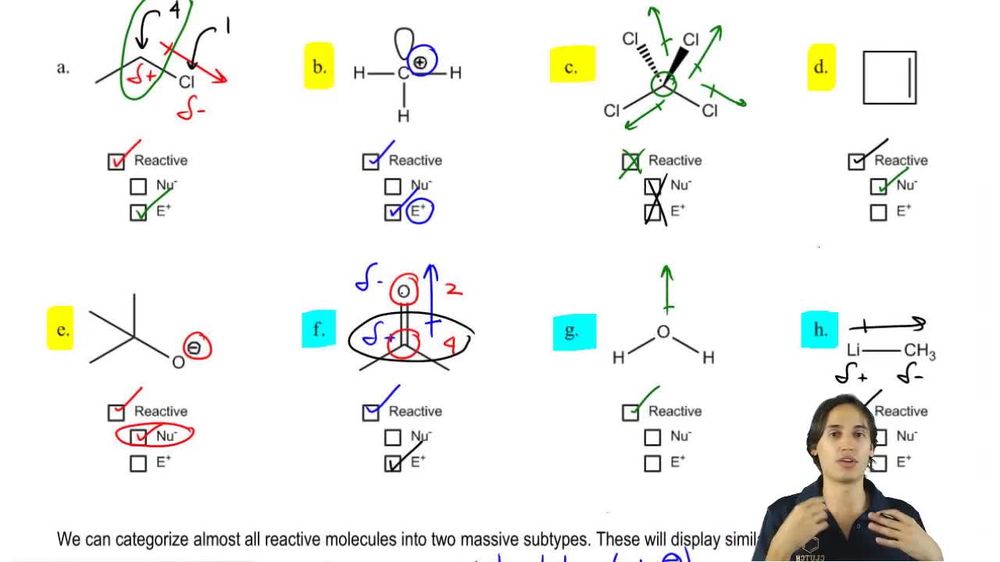
Determine the electron-rich (nucleophilic) and electron-deficient (electrophilic) sites in the reactant. This will help you identify where the reaction starts and how the electrons will move.
Draw the first curved arrow to represent the movement of a pair of electrons. For example, if a nucleophile attacks an electrophile, the arrow should start at the nucleophile's lone pair or π-bond and point toward the electrophilic atom.
Draw the second curved arrow to show the departure of a leaving group or the rearrangement of electrons. This ensures that the octet rule is satisfied for all atoms involved in the reaction.
Verify the mechanism by ensuring that the product matches the structure on the right. Check that all charges, bonds, and formalities are consistent with the reaction mechanism.
Verified video answer for a similar problem:
This video solution was recommended by our tutors as helpful for the problem above
Play a video:
0 Comments
Key Concepts
Here are the essential concepts you must grasp in order to answer the question correctly.
Arrow-Pushing Mechanism
Arrow-pushing mechanisms are diagrams used in organic chemistry to illustrate the movement of electrons during chemical reactions. The arrows indicate the direction of electron flow, with one arrow representing the movement of a pair of electrons and another showing the movement of a single electron. This visual representation helps chemists understand how reactants transform into products, highlighting the role of nucleophiles and electrophiles.
Nucleophiles are species that donate an electron pair to form a chemical bond, while electrophiles are electron-deficient species that accept electron pairs. Understanding the roles of these two types of reactants is crucial for predicting the outcome of a reaction. In many organic reactions, nucleophiles attack electrophiles, leading to the formation of new bonds and the rearrangement of atoms.
A reaction mechanism is a step-by-step description of the process by which reactants convert into products. It outlines the sequence of bond-breaking and bond-forming events, including intermediates and transition states. Analyzing the mechanism allows chemists to predict reaction outcomes, understand reaction rates, and design new synthetic pathways, making it a fundamental concept in organic chemistry.


 Verified step by step guidance
 04:32
04:32