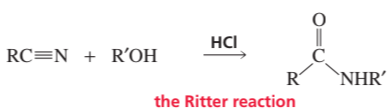
The reaction of a nitrile with an alcohol in the presence of a strong acid forms an N-substituted amide. This reaction, known as the Ritter reaction, does not work with primary alcohols. a. Propose a mechanism for the Ritter reaction.
Verified step by step guidance
1
Step 1: Protonation of the nitrile group - In the presence of a strong acid like HCl, the nitrile group (RC≡N) is protonated. This increases the electrophilicity of the carbon atom in the nitrile group, making it more susceptible to nucleophilic attack.
Step 2: Formation of a carbocation from the alcohol - The strong acid also protonates the alcohol (R'OH), leading to the loss of water and the formation of a carbocation (R'+). This step is crucial and explains why the reaction does not work with primary alcohols, as primary carbocations are unstable.
Step 3: Nucleophilic attack by the nitrile - The carbocation (R'+) formed from the alcohol reacts with the nitrogen atom of the protonated nitrile group. This step forms an intermediate species where the nitrogen is bonded to the R' group.
Step 4: Hydrolysis of the intermediate - Water or another nucleophile attacks the intermediate, leading to the cleavage of the triple bond and the formation of an amide functional group (RC=O(NHR')).
Step 5: Deprotonation to form the final product - The final step involves deprotonation of the amide intermediate to yield the N-substituted amide (RC=O(NHR')). This completes the Ritter reaction mechanism.
Verified video answer for a similar problem:
This video solution was recommended by our tutors as helpful for the problem above
Video duration:
8m
Play a video:
0 Comments
Key Concepts
Here are the essential concepts you must grasp in order to answer the question correctly.
Nitriles
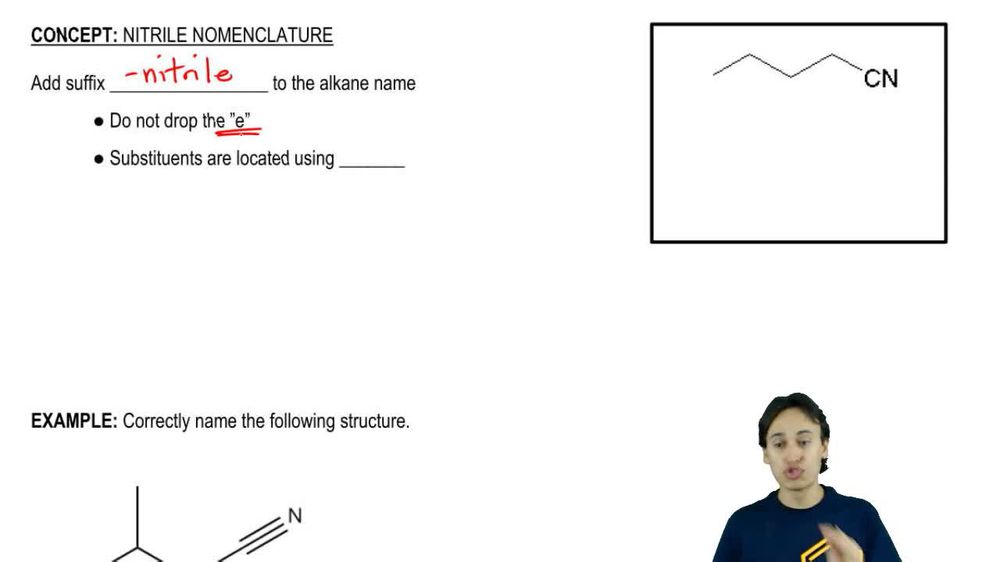
Nitriles are organic compounds containing a cyano group (-C≡N), which consists of a carbon triple-bonded to a nitrogen atom. They are important intermediates in organic synthesis and can be converted into various functional groups, including amides. Understanding the reactivity of nitriles is crucial for proposing mechanisms involving their transformation in reactions like the Ritter reaction.
The Ritter reaction involves the nucleophilic attack of an alcohol on a nitrile in the presence of a strong acid, leading to the formation of an N-substituted amide. The mechanism typically includes protonation of the nitrile, followed by nucleophilic attack by the alcohol, and subsequent rearrangement to yield the final product. Familiarity with this mechanism is essential for understanding how the reaction proceeds and the role of each reactant.
In the Ritter reaction, a strong acid, such as HCl, is used to protonate the nitrile, enhancing its electrophilicity and facilitating the nucleophilic attack by the alcohol. The acid also helps in stabilizing the transition state during the reaction. Recognizing the importance of acid catalysis is vital for grasping how the reaction conditions influence the outcome and efficiency of the Ritter reaction.