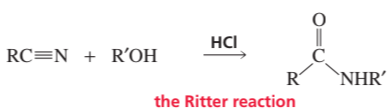
The reaction of a nitrile with an alcohol in the presence of a strong acid forms an N-substituted amide. This reaction, known as the Ritter reaction, does not work with primary alcohols. b. Why does the Ritter reaction not work with primary alcohols?
Verified step by step guidance
1
The Ritter reaction involves the reaction of a nitrile (RC≡N) with an alcohol (R'OH) in the presence of a strong acid (e.g., HCl) to form an N-substituted amide (RC=O(NHR')). The mechanism relies on the formation of a carbocation intermediate from the alcohol.
In the first step of the reaction, the strong acid protonates the alcohol (R'OH), forming R'OH₂⁺. This protonated alcohol is highly unstable and loses water to generate a carbocation (R'⁺).
The stability of the carbocation is critical for the reaction to proceed. Secondary and tertiary alcohols can form stable carbocations due to hyperconjugation and inductive effects, but primary alcohols cannot form stable carbocations because primary carbocations are highly unstable and prone to rearrangement or decomposition.
Since the Ritter reaction requires a stable carbocation intermediate for the nitrile to attack, primary alcohols are not suitable substrates. The instability of the primary carbocation prevents the reaction from proceeding efficiently.
In summary, the Ritter reaction does not work with primary alcohols because the formation of a stable carbocation intermediate is not possible, which is a key step in the reaction mechanism.
Verified video answer for a similar problem:
This video solution was recommended by our tutors as helpful for the problem above
Video duration:
12m
Play a video:
0 Comments
Key Concepts
Here are the essential concepts you must grasp in order to answer the question correctly.
Ritter Reaction
The Ritter reaction is a chemical reaction that involves the conversion of a nitrile and an alcohol into an N-substituted amide in the presence of a strong acid, typically hydrochloric acid. This reaction is significant in organic synthesis as it allows for the formation of amides, which are important functional groups in various chemical compounds. The mechanism involves protonation of the alcohol, followed by nucleophilic attack by the nitrile.
Nucleophilicity refers to the ability of a nucleophile to donate an electron pair to an electrophile, forming a chemical bond. In the context of the Ritter reaction, the alcohol acts as a nucleophile. Primary alcohols are less nucleophilic compared to secondary or tertiary alcohols due to steric hindrance and the stability of the resulting carbocation, which affects their reactivity in this specific reaction.
Steric hindrance is the prevention of reactions at a particular location in a molecule due to the size of substituent groups. In the case of primary alcohols, the steric bulk around the hydroxyl group can hinder the approach of the nitrile, making it less favorable for the nucleophilic attack necessary for the Ritter reaction. This is why primary alcohols do not effectively participate in this reaction, unlike their secondary and tertiary counterparts.