a. Which of the following reactions does not give the carbonyl product shown? b. Which of the reactions that do not occur can be made to occur if an acid catalyst is added to the reaction mixture? 5.
Verified step by step guidance
1
Step 1: Analyze the first reaction (5). The reaction involves a carbonyl compound reacting with CH3NH2 (methylamine) under heat (Δ). This is a nucleophilic addition-elimination reaction, where the amine attacks the carbonyl carbon, forming an imine (Schiff base). Consider whether this reaction would proceed under the given conditions and whether the carbonyl product would remain intact.
Step 2: Analyze the second reaction (6). The reaction involves a carbonyl compound reacting with Cl⁻ (chloride ion). Chloride is a weak nucleophile, and carbonyl compounds are generally not reactive enough to undergo nucleophilic substitution with chloride ions under neutral conditions. Consider whether this reaction would proceed and whether the carbonyl product would remain intact.
Step 3: For part (a), determine which reaction does not give the carbonyl product shown. Compare the reactivity of the carbonyl compound with the given reagents (CH3NH2 and Cl⁻) and assess whether the carbonyl group is retained or transformed in each case.
Step 4: For part (b), consider the role of an acid catalyst. Acid catalysts can protonate the carbonyl oxygen, increasing the electrophilicity of the carbonyl carbon and making it more susceptible to nucleophilic attack. Evaluate whether adding an acid catalyst would enable the reaction with Cl⁻ to proceed.
Step 5: Summarize your findings. Identify which reaction does not give the carbonyl product and explain how the addition of an acid catalyst could make the reaction occur. Ensure that your reasoning is based on the principles of nucleophilic addition and the effect of acid catalysis on carbonyl reactivity.
Verified video answer for a similar problem:
This video solution was recommended by our tutors as helpful for the problem above
Video duration:
4m
Play a video:
0 Comments
Key Concepts
Here are the essential concepts you must grasp in order to answer the question correctly.
Carbonyl Compounds
Carbonyl compounds are organic molecules that contain a carbon atom double-bonded to an oxygen atom (C=O). They are key functional groups in organic chemistry, including aldehydes and ketones. Understanding the structure and reactivity of carbonyl compounds is essential for predicting the outcomes of various chemical reactions, particularly those involving nucleophiles.
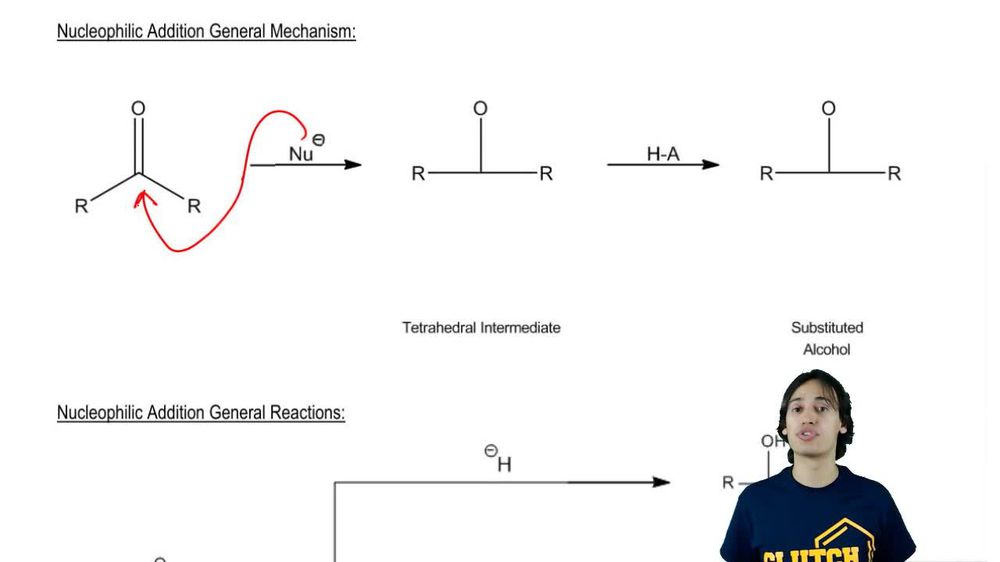
Nucleophilic addition reactions involve the attack of a nucleophile on the electrophilic carbon of a carbonyl group. This reaction is fundamental in organic chemistry, as it leads to the formation of alcohols, amines, and other functional groups. Recognizing the conditions under which these reactions occur, including the presence of catalysts, is crucial for understanding the reactivity of carbonyl compounds.
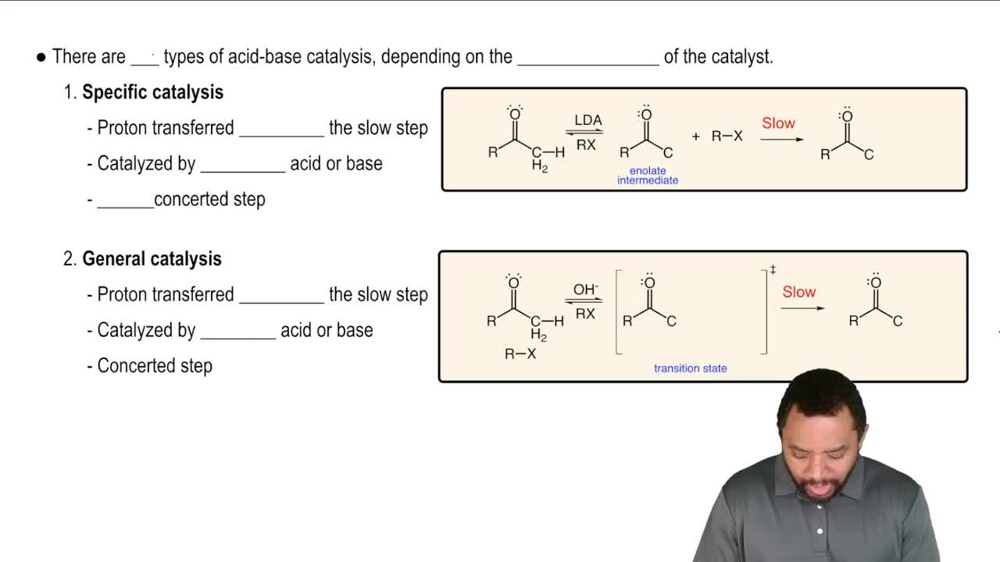
Acid catalysis refers to the acceleration of a chemical reaction by the addition of an acid, which can enhance the electrophilicity of a carbonyl carbon. In many reactions, such as those involving carbonyl compounds, the presence of an acid can facilitate the formation of intermediates that are more reactive, thus allowing reactions that would otherwise not occur to proceed. This concept is vital for manipulating reaction pathways in organic synthesis.

 4:52 minutes
 Verified step by step guidance
 01:40
01:40