Show how hex-1-yne might be converted to d. 1,1,2,2-tetrabromohexane.
Verified step by step guidance
1
Identify the starting material and the target product. The starting material is hex-1-yne, which is an alkyne, and the target product is 1,1,2,2-tetrabromohexane, which is a fully saturated alkane with four bromine atoms attached to the first and second carbons.
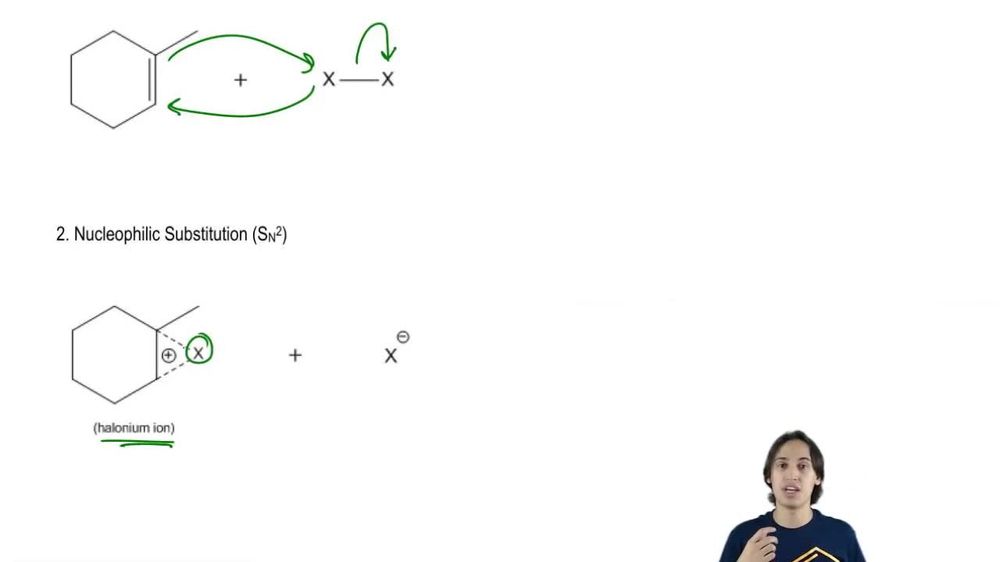
Recognize that the reaction involves the addition of bromine (Br₂) to the alkyne. This process occurs in two steps: (1) addition of bromine to the triple bond to form a dibromoalkene, and (2) further addition of bromine to the double bond to form the tetrabromoalkane.
In the first step, treat hex-1-yne with one equivalent of bromine (Br₂) in an inert solvent like CCl₄. This will result in the formation of 1,2-dibromohex-1-ene. The bromine atoms will add across the triple bond in an anti-addition manner, forming a trans-dibromoalkene.
In the second step, treat the 1,2-dibromohex-1-ene with another equivalent of bromine (Br₂) in the same solvent. This will result in the addition of two more bromine atoms across the double bond, forming 1,1,2,2-tetrabromohexane. The addition will again proceed via anti-addition.
Finally, confirm the structure of the product. The resulting compound, 1,1,2,2-tetrabromohexane, will have two bromine atoms attached to the first carbon and two bromine atoms attached to the second carbon, with the rest of the molecule being a fully saturated alkane chain.
Verified video answer for a similar problem:
This video solution was recommended by our tutors as helpful for the problem above
Video duration:
2m
Play a video:
0 Comments
Key Concepts
Here are the essential concepts you must grasp in order to answer the question correctly.
Alkyne Reactivity
Alkynes, such as hex-1-yne, are hydrocarbons containing a carbon-carbon triple bond. This triple bond makes them highly reactive, particularly in addition reactions. Understanding how alkynes can undergo reactions with halogens is crucial for converting them into more complex molecules, such as tetrabromo derivatives.
Halogenation is a chemical reaction where halogens (like bromine) are added to a compound. In the case of alkynes, this process can lead to the formation of vicinal dibromides. For hex-1-yne to be converted to 1,1,2,2-tetrabromohexane, multiple halogenation steps are required, which involve the addition of bromine across the triple bond.
Stereochemistry refers to the spatial arrangement of atoms in molecules and how this affects their chemical behavior. In the conversion of hex-1-yne to 1,1,2,2-tetrabromohexane, understanding the stereochemical outcomes of halogenation is important, as the product will have specific stereochemical configurations that influence its properties and reactivity.