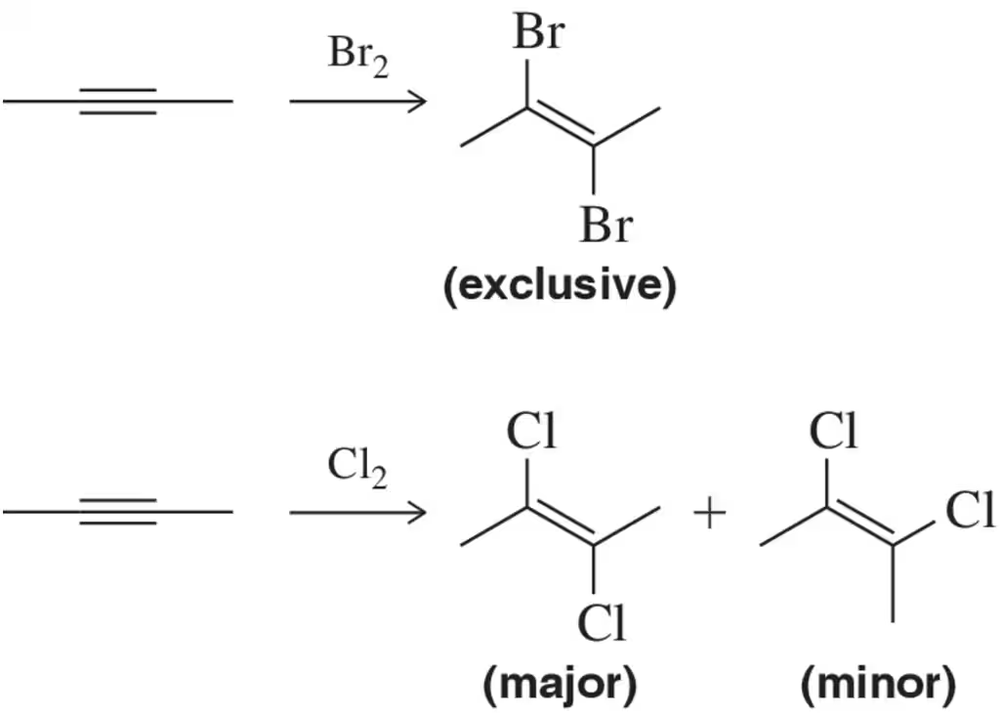
Trans addition is heavily favored for the addition of Br₂ and Cl₂ to alkynes. With chlorination, however, more of the syn addition product is formed. Rationalize this fact in light of your answer to Assessments 10.50 and 10.51.
Verified step by step guidance
1
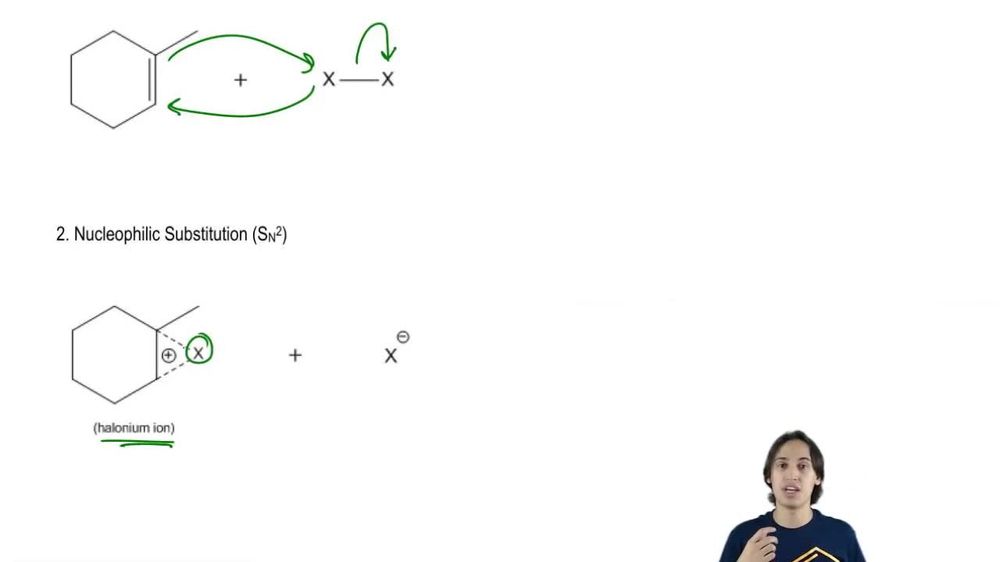
Understand the mechanism of halogen addition to alkynes: When Br₂ or Cl₂ is added to an alkyne, the reaction typically proceeds through a halonium ion intermediate. This intermediate is a three-membered ring structure where the halogen is bonded to both carbons of the alkyne, creating a strained cyclic structure.
Analyze the stereochemistry of the addition: In the case of Br₂, the halonium ion intermediate is more stable due to the larger size and polarizability of bromine. This stability favors a trans addition mechanism, where the nucleophilic attack by the second halide ion occurs on the opposite side of the halonium ion, leading to anti stereochemistry.
Consider the differences with Cl₂: Chlorine is smaller and less polarizable than bromine, which makes the halonium ion intermediate less stable. This reduced stability allows for a competing pathway where the addition occurs via a concerted mechanism, leading to some syn addition products.
Relate this to the experimental observation: The higher proportion of syn addition products in chlorination can be rationalized by the fact that the less stable chloronium ion intermediate allows for alternative reaction pathways, such as direct concerted addition, which does not involve the formation of a halonium ion.
Conclude the reasoning: The difference in the stereochemical outcome between bromination and chlorination is due to the relative stability of the halonium ion intermediates. Bromine's larger size and polarizability favor trans addition, while chlorine's smaller size and lower polarizability allow for more syn addition products to form.
Verified video answer for a similar problem:
This video solution was recommended by our tutors as helpful for the problem above
Video duration:
1m
Play a video:
0 Comments
Key Concepts
Here are the essential concepts you must grasp in order to answer the question correctly.
Alkyne Reactivity
Alkynes are unsaturated hydrocarbons containing at least one carbon-carbon triple bond. Their reactivity is significantly influenced by the nature of the substituents and the type of addition reactions they undergo. In the case of halogen addition, alkynes can react with diatomic halogens like Br₂ and Cl₂, leading to the formation of vicinal dihalides through either syn or anti addition mechanisms.
In organic chemistry, syn addition refers to the addition of two substituents to the same side of a double or triple bond, while anti addition involves adding them to opposite sides. The stereochemistry of the addition can affect the stability and formation of products. For alkynes, syn addition is often favored under certain conditions, particularly with chlorination, due to steric and electronic factors that stabilize the transition state.
The halogenation of alkynes typically proceeds through a cyclic halonium ion intermediate, which can lead to different stereochemical outcomes depending on the conditions. For bromination and chlorination, the formation of the halonium ion allows for both syn and anti addition pathways. The preference for syn addition in chlorination can be attributed to the lower steric hindrance and the ability of the halogen to stabilize the transition state more effectively than in bromination.