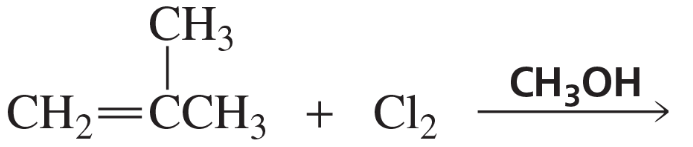
Each of the following reactions has two nucleophiles that could add to the intermediate formed by the reaction of the alkene with an electrophile. What is the major product of each reaction? a.
Verified step by step guidance
1
Step 1: Analyze the reaction conditions. The reactants include an alkene (CH2=CCH3 with a methyl group attached to the double bond), chlorine (Cl2), and methanol (CH3OH). This suggests an electrophilic addition reaction where Cl2 acts as the electrophile and CH3OH can act as a nucleophile.
Step 2: Understand the mechanism. The alkene reacts with Cl2, leading to the formation of a cyclic chloronium ion intermediate. This intermediate is highly reactive and can be attacked by nucleophiles.
Step 3: Identify the nucleophiles. In this reaction, the two nucleophiles are chloride ion (Cl⁻) and methanol (CH3OH). Both can attack the cyclic chloronium ion, but the major product will depend on steric and electronic factors.
Step 4: Predict the major product. Methanol (CH3OH) is a neutral nucleophile and typically attacks the more substituted carbon of the cyclic chloronium ion due to steric hindrance and stability considerations. This leads to the formation of a product where methanol adds to the more substituted carbon and chloride adds to the less substituted carbon.
Step 5: Draw the final structure. The major product will have a chlorine atom attached to the less substituted carbon of the original double bond and a methoxy group (-OCH3) attached to the more substituted carbon. This follows Markovnikov's rule and the stereochemistry of the reaction.
Verified video answer for a similar problem:
This video solution was recommended by our tutors as helpful for the problem above
Video duration:
3m
Play a video:
0 Comments
Key Concepts
Here are the essential concepts you must grasp in order to answer the question correctly.
Nucleophiles and Electrophiles
Nucleophiles are species that donate an electron pair to form a chemical bond, while electrophiles are electron-deficient species that accept an electron pair. In organic reactions, the interaction between nucleophiles and electrophiles is fundamental, as it drives the formation of new bonds. Understanding the nature of these species helps predict the outcome of reactions involving alkenes and other functional groups.
Markovnikov's Rule states that in the addition of HX to an alkene, the hydrogen atom will attach to the carbon with the greater number of hydrogen atoms already attached. This principle helps determine the regioselectivity of electrophilic additions, guiding the prediction of major products in reactions involving alkenes and electrophiles.
Understanding reaction mechanisms is crucial for predicting the products of organic reactions. A mechanism outlines the step-by-step process of how reactants transform into products, including the formation of intermediates. In the context of alkene reactions, recognizing the formation of carbocation intermediates and subsequent nucleophilic attacks is essential for determining the major product.