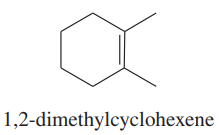
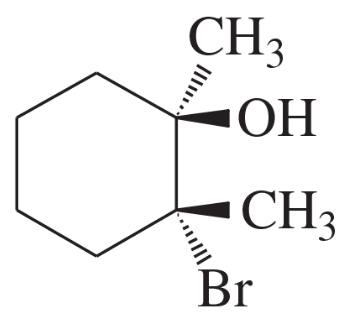
Using 1,2-dimethylcyclohexene as your starting material, show how you would synthesize the following compounds. (Once you have shown how to synthesize a compound, you may use it as the starting material in any later parts of this problem.) If a chiral product is shown, assume that it is part of a racemic mixture. (g)
Verified step by step guidance
1
Step 1: Begin with the starting material, 1,2-dimethylcyclohexene. The goal is to add both a hydroxyl group (-OH) and a bromine atom (-Br) to the double bond in a stereospecific manner.
Step 2: Perform a bromohydrin formation reaction. Treat 1,2-dimethylcyclohexene with bromine (Br2) in the presence of water (H2O). This reaction proceeds via anti-addition, meaning the bromine and hydroxyl group will add to opposite faces of the double bond.
Step 3: The bromine atom will add to one carbon of the double bond, and the hydroxyl group will add to the other carbon. The stereochemistry of the product will result in the bromine and hydroxyl group being anti to each other (on opposite sides of the ring).
Step 4: Ensure that the product is a racemic mixture, as the reaction does not favor one enantiomer over the other. This is due to the planar nature of the double bond, allowing attack from either side.
Step 5: Verify the final structure of the product, which should match the target compound shown in the image, with the bromine and hydroxyl group on opposite faces of the ring and the methyl groups retaining their original positions.
Verified video answer for a similar problem:
This video solution was recommended by our tutors as helpful for the problem above
Video duration:
2m
Play a video:
0 Comments
Key Concepts
Here are the essential concepts you must grasp in order to answer the question correctly.
Electrophilic Addition Reactions
Electrophilic addition reactions are fundamental in organic chemistry, particularly for alkenes like 1,2-dimethylcyclohexene. In these reactions, an electrophile reacts with the double bond of the alkene, leading to the formation of a more saturated product. Understanding the mechanism of these reactions, including the formation of carbocations and the regioselectivity of the addition, is crucial for synthesizing various compounds from alkenes.
Stereochemistry is the study of the spatial arrangement of atoms in molecules and how this affects their chemical behavior. In the context of synthesizing chiral compounds, it is essential to understand concepts like chirality, enantiomers, and diastereomers. This knowledge is particularly important when dealing with racemic mixtures, as it influences the properties and reactivity of the synthesized products.
Functional group transformations involve converting one functional group into another, which is a key strategy in organic synthesis. For example, converting an alkene to an alcohol or a halide can be achieved through various reactions such as hydrohalogenation or hydration. Mastery of these transformations allows chemists to design synthetic pathways to create desired compounds from simpler starting materials like 1,2-dimethylcyclohexene.