A graduate student attempted to form the iodohydrin of the alkene shown below. Her analysis of the products showed a good yield of an unexpected product. Propose a mechanism to explain the formation of this product.
Verified step by step guidance
1
Step 1: Analyze the starting material and reaction conditions. The starting material is a cyclic enone with an alcohol group. The reaction conditions involve iodine (I₂) and water (H₂O), which typically facilitate halohydrin formation or electrophilic addition reactions.
Step 2: Consider the electrophilic addition mechanism. Iodine (I₂) can act as an electrophile, reacting with the alkene in the enone to form a cyclic iodonium ion intermediate. This intermediate is highly reactive and can undergo nucleophilic attack.
Step 3: Examine the role of water as a nucleophile. Water can attack the cyclic iodonium ion, leading to the formation of a halohydrin. However, the observed product suggests an alternative pathway involving intramolecular interactions.
Step 4: Propose an intramolecular nucleophilic attack mechanism. The hydroxyl group (-OH) on the starting material can act as a nucleophile, attacking the cyclic iodonium ion. This intramolecular attack leads to the formation of a bicyclic structure with an iodine atom and an ester functional group.
Step 5: Rationalize the stereochemistry of the product. The side view of the product indicates that the iodine atom and the ester group are positioned in a specific stereochemical arrangement. This stereochemistry arises from the constraints of the cyclic structure and the intramolecular attack mechanism.
Verified video answer for a similar problem:
This video solution was recommended by our tutors as helpful for the problem above
Video duration:
3m
Play a video:
0 Comments
Key Concepts
Here are the essential concepts you must grasp in order to answer the question correctly.
Iodohydrin Formation
Iodohydrin formation involves the addition of iodine (I2) and water (H2O) across a double bond in an alkene. This reaction typically proceeds through the formation of a cyclic halonium ion intermediate, which is then attacked by water, leading to the formation of an iodohydrin. Understanding this mechanism is crucial for predicting the products formed in the reaction.
The mechanism of electrophilic addition describes how alkenes react with electrophiles, such as iodine, to form more stable products. The double bond acts as a nucleophile, attacking the electrophile and forming a carbocation or a cyclic intermediate. This concept is essential for understanding how the unexpected product may arise from the reaction conditions or the structure of the alkene.
Stereochemistry refers to the spatial arrangement of atoms in molecules and how this affects their chemical behavior. In the case of iodohydrin formation, the stereochemistry of the product can lead to different isomers, including enantiomers or diastereomers. Analyzing the stereochemical outcomes is important for explaining the unexpected product observed in the student's analysis.

 3:51 minutes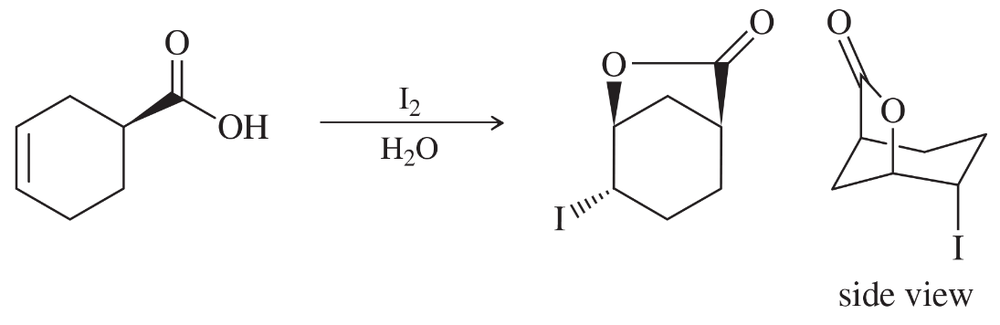
 Verified step by step guidance
 02:26
02:26