Primary alcohols have a strong peak at m/z = 31. a. What fragment is responsible for this peak?
Verified step by step guidance
1
Identify the structure of a primary alcohol. A primary alcohol has the general formula R-CH2OH, where R is an alkyl group.
Understand the process of fragmentation in mass spectrometry. When a primary alcohol is ionized, it can break into smaller fragments, producing characteristic peaks in the mass spectrum.
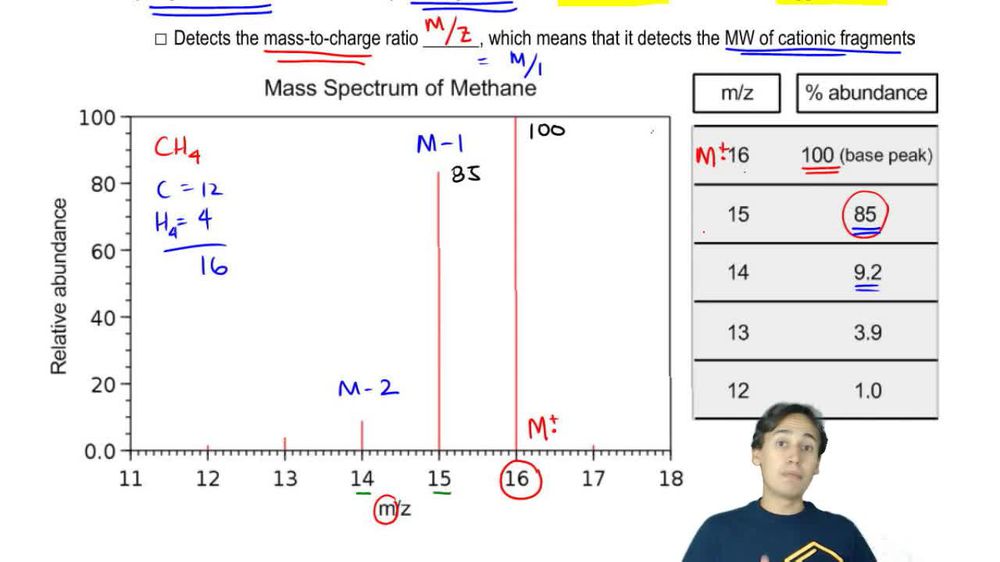
Determine the fragment responsible for the peak at m/z = 31. The m/z value corresponds to the mass-to-charge ratio of the fragment. For m/z = 31, the fragment must have a molecular weight of 31 and a single positive charge.
Analyze the possible fragments of a primary alcohol. The hydroxymethyl group (CH2OH) is a common fragment in primary alcohols. Its molecular weight is calculated as follows: Carbon (12) + 2 Hydrogens (2 × 1) + Oxygen (16) = 31.
Conclude that the fragment responsible for the peak at m/z = 31 is the hydroxymethyl cation (CH2OH⁺), which forms when the primary alcohol undergoes fragmentation during ionization.
Verified video answer for a similar problem:
This video solution was recommended by our tutors as helpful for the problem above
Video duration:
3m
Play a video:
0 Comments
Key Concepts
Here are the essential concepts you must grasp in order to answer the question correctly.
Mass Spectrometry
Mass spectrometry is an analytical technique used to measure the mass-to-charge ratio of ions. It helps in identifying the composition of a sample by generating a mass spectrum, which displays the different ions produced during ionization. Understanding mass spectrometry is crucial for interpreting the peaks in the spectrum, such as the one at m/z = 31 for primary alcohols.
Fragmentation patterns refer to the specific ways in which molecules break apart during mass spectrometry. Different functional groups and molecular structures lead to characteristic fragments. For primary alcohols, the peak at m/z = 31 typically corresponds to the loss of a hydroxyl group (–OH) and a hydrogen atom, resulting in the formation of a fragment ion that can be identified in the mass spectrum.
Primary alcohols are organic compounds where the hydroxyl group (–OH) is attached to a carbon atom that is only connected to one other carbon atom. This structural characteristic influences their reactivity and fragmentation behavior in mass spectrometry. Recognizing the structure of primary alcohols is essential for understanding the origin of specific mass spectral peaks, including the one at m/z = 31.