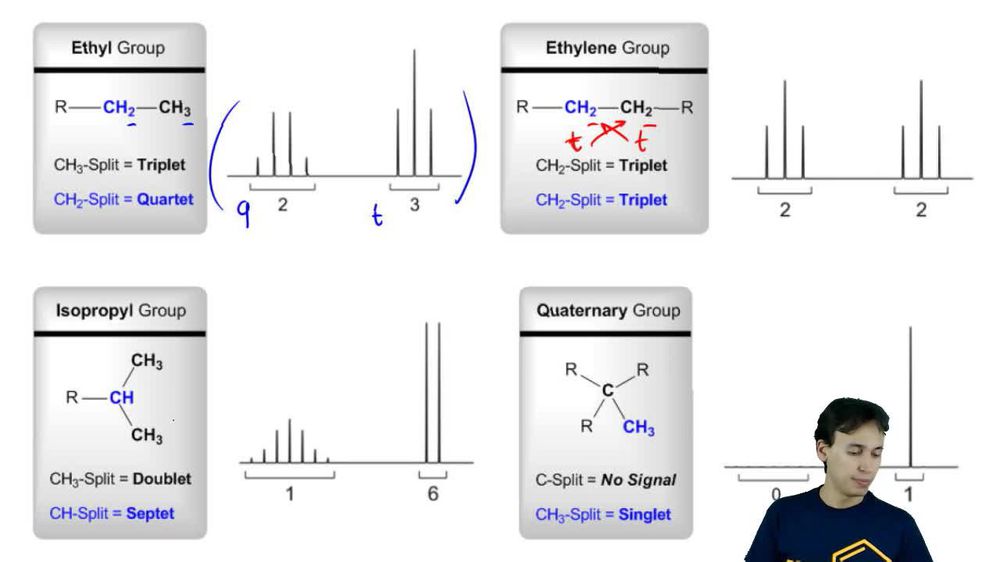
Show the fragmentations that give rise to the peaks at m/z 43, 57, and 85 in the mass spectrum of 2,4-dimethylpentane (Figure 12-17). <IMAGE>
Verified step by step guidance
1
Step 1: Begin by understanding the structure of 2,4-dimethylpentane. It is a branched alkane with the molecular formula C7H16. Visualize its structure to identify possible fragmentation patterns.
Step 2: Recall that mass spectrometry involves ionization of the molecule, typically forming a molecular ion (M⁺). Fragmentation occurs when bonds break, forming smaller ions. Each fragment corresponds to a peak in the mass spectrum, with the m/z value representing the mass-to-charge ratio.
Step 3: For the peak at m/z 43, consider the formation of a fragment ion by cleaving a bond near a methyl group. A common fragment with m/z 43 is the propyl cation (C3H7⁺). This can result from the loss of larger alkyl groups from the parent molecule.
Step 4: For the peak at m/z 57, analyze the possibility of forming a butyl cation (C4H9⁺). This can occur by breaking bonds around the central carbon atoms, leading to the loss of smaller alkyl groups while retaining a larger fragment.
Step 5: For the peak at m/z 85, consider the formation of a pentyl cation (C5H11⁺). This fragment is larger and results from cleaving bonds that leave behind a significant portion of the original molecule. Ensure to account for the branching in 2,4-dimethylpentane when identifying the specific bonds that break.
Verified video answer for a similar problem:
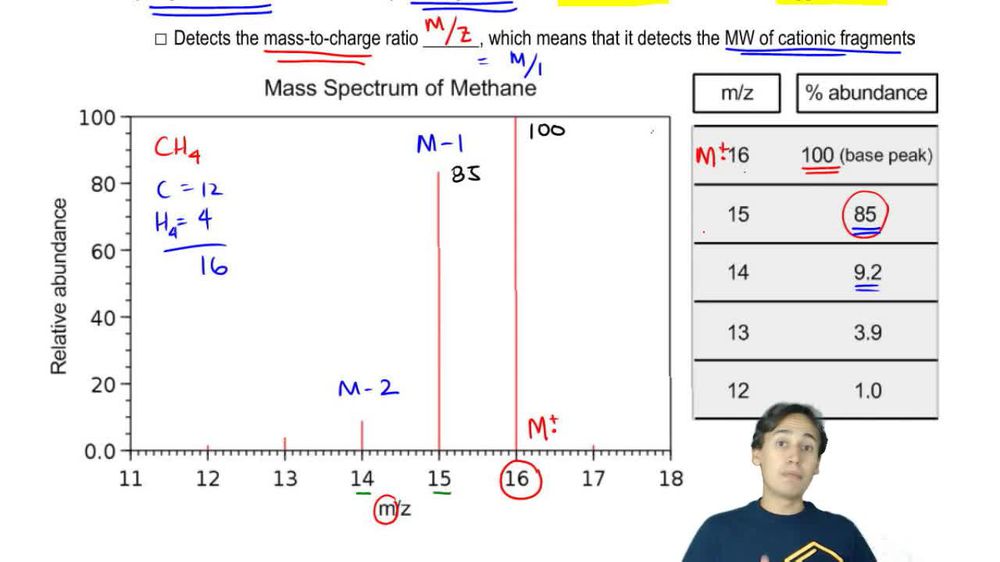
This video solution was recommended by our tutors as helpful for the problem above
Video duration:
3m
Play a video:
0 Comments
Key Concepts
Here are the essential concepts you must grasp in order to answer the question correctly.
Mass Spectrometry
Mass spectrometry is an analytical technique used to measure the mass-to-charge ratio of ions. It involves ionizing chemical species and sorting the ions based on their mass. The resulting mass spectrum displays peaks corresponding to different ions, where the m/z (mass-to-charge) values indicate the mass of the fragments produced from the original molecule.
Fragmentation patterns refer to the specific ways in which a molecule breaks apart during ionization in mass spectrometry. These patterns are influenced by the molecular structure and stability of the resulting fragments. Understanding these patterns is crucial for interpreting mass spectra, as they help identify the structure of the original compound based on the observed m/z values.
2,4-Dimethylpentane is a branched alkane with a specific arrangement of carbon atoms and methyl groups. Its structure influences the fragmentation pathways during mass spectrometry. Recognizing the molecular structure allows for predicting which fragments will form and their corresponding m/z values, essential for explaining the peaks at m/z 43, 57, and 85 in the mass spectrum.