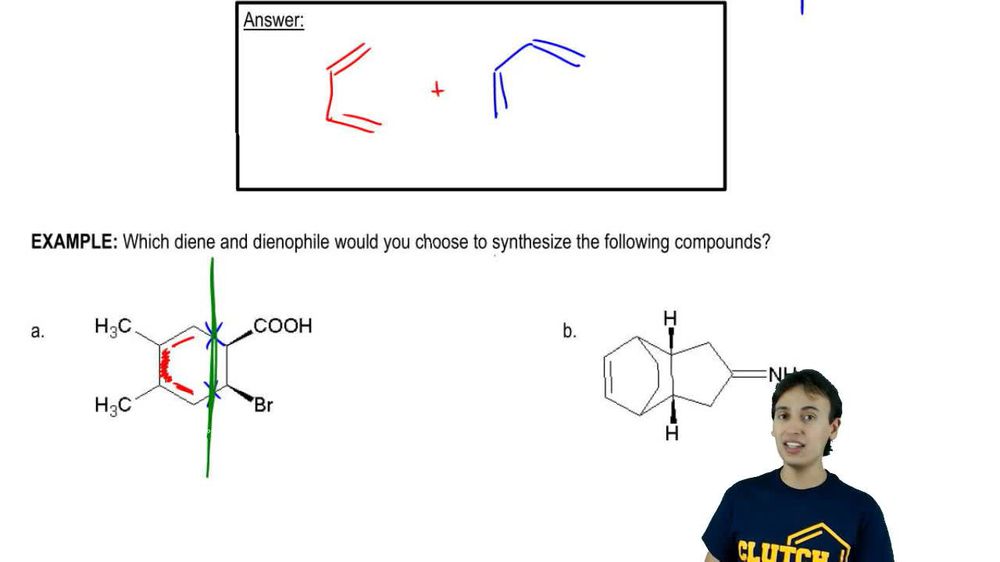
How could you prepare the following compounds from the given starting materials? b.
Verified step by step guidance
1
Identify the starting material and the target compound. The starting material is a dichloroalkane, and the target compound is a cyclohexane derivative with three methyl groups.
Recognize that the transformation involves forming a six-membered ring. This suggests a cyclization reaction, likely through an intramolecular nucleophilic substitution.
Consider the mechanism: the chlorine atoms in the starting material can act as leaving groups. A base can be used to deprotonate one of the carbon atoms adjacent to a chlorine, forming a carbanion.
The carbanion can then perform a nucleophilic attack on the other carbon bearing a chlorine atom, leading to the formation of a cyclohexane ring and the elimination of a chloride ion.
Ensure that the reaction conditions are suitable for promoting cyclization, such as using a strong base like sodium ethoxide (NaOEt) in an appropriate solvent to facilitate the intramolecular reaction.
Verified video answer for a similar problem:
This video solution was recommended by our tutors as helpful for the problem above
Video duration:
8m
Play a video:
0 Comments
Key Concepts
Here are the essential concepts you must grasp in order to answer the question correctly.
Diels-Alder Reaction
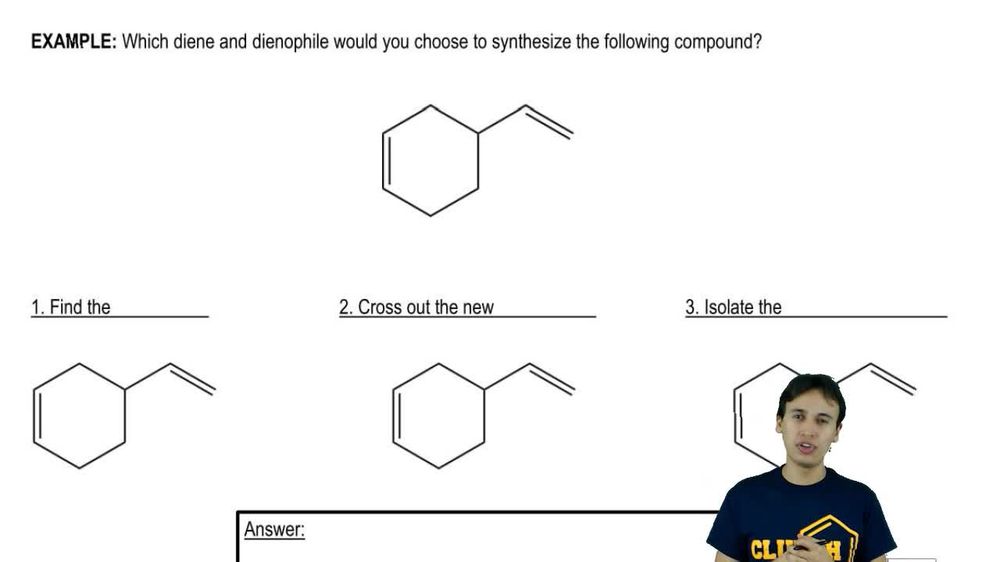
The Diels-Alder reaction is a [4+2] cycloaddition reaction between a conjugated diene and a dienophile, resulting in the formation of a six-membered ring. This reaction is a key method in organic synthesis for constructing cyclic compounds and is characterized by its stereospecificity and ability to form new carbon-carbon bonds.
Retrosynthetic analysis is a problem-solving technique used in organic chemistry to deconstruct complex molecules into simpler starting materials. By working backward from the target compound, chemists can identify potential synthetic routes and the necessary reactions, facilitating the design of a synthesis plan.
Halogenated compounds, such as those containing chlorine, are often more reactive than their non-halogenated counterparts due to the presence of electronegative halogen atoms. These compounds can participate in various reactions, including nucleophilic substitutions and eliminations, which are crucial for forming the diene or dienophile in a Diels-Alder reaction.

 8:43 minutes
 Verified step by step guidance
 04:02
04:02