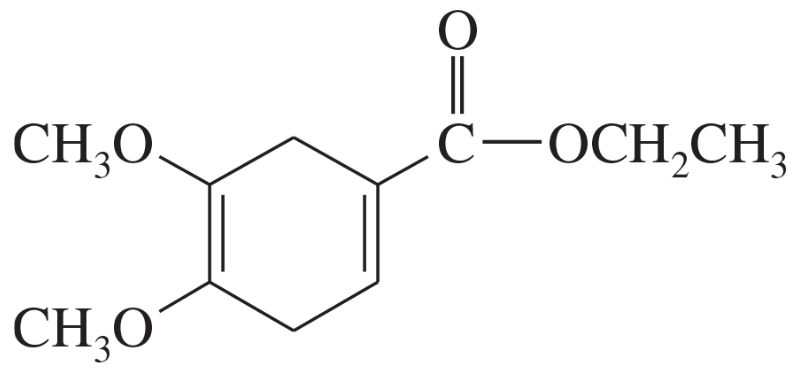
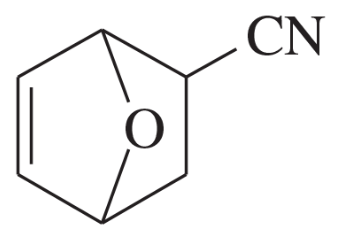
What dienes and dienophiles would react to give the following Diels–Alder products? (a) (b) (c)
Verified step by step guidance
1
Step 1: Analyze the Diels–Alder product structure to identify the diene and dienophile components. The Diels–Alder reaction involves a conjugated diene reacting with a dienophile (an electron-deficient alkene or alkyne). Look for the cyclohexene ring in the product, which is characteristic of this reaction.
Step 2: For product (a), observe the cyclohexene ring with a ketone group (COCH₃) attached. The diene must have two conjugated double bonds, and the dienophile must contain a carbonyl group (C=O) to form this product. The diene is likely 1,3-cyclopentadiene, and the dienophile is methyl vinyl ketone (CH₂=CHCOCH₃).
Step 3: For product (b), observe the aromatic ring with a ketone group (COOCH₂CH₃) attached. The diene must have two conjugated double bonds, and the dienophile must contain an ester group (COOCH₂CH₃). The diene is likely 1,3-butadiene, and the dienophile is ethyl acrylate (CH₂=CHCOOCH₂CH₃).
Step 4: For product (c), observe the cyclohexene ring with a nitrile group (CN) attached. The diene must have two conjugated double bonds, and the dienophile must contain a nitrile group (C≡N). The diene is likely furan (a heterocyclic diene), and the dienophile is acrylonitrile (CH₂=CHCN).
Step 5: Verify the stereochemistry and regiochemistry of the products. The Diels–Alder reaction is stereospecific, meaning the stereochemistry of the diene and dienophile will influence the final product. Ensure that the substituents on the diene and dienophile align correctly to form the observed products.
Verified video answer for a similar problem:
This video solution was recommended by our tutors as helpful for the problem above
Video duration:
4m
Play a video:
0 Comments
Key Concepts
Here are the essential concepts you must grasp in order to answer the question correctly.
Diels–Alder Reaction
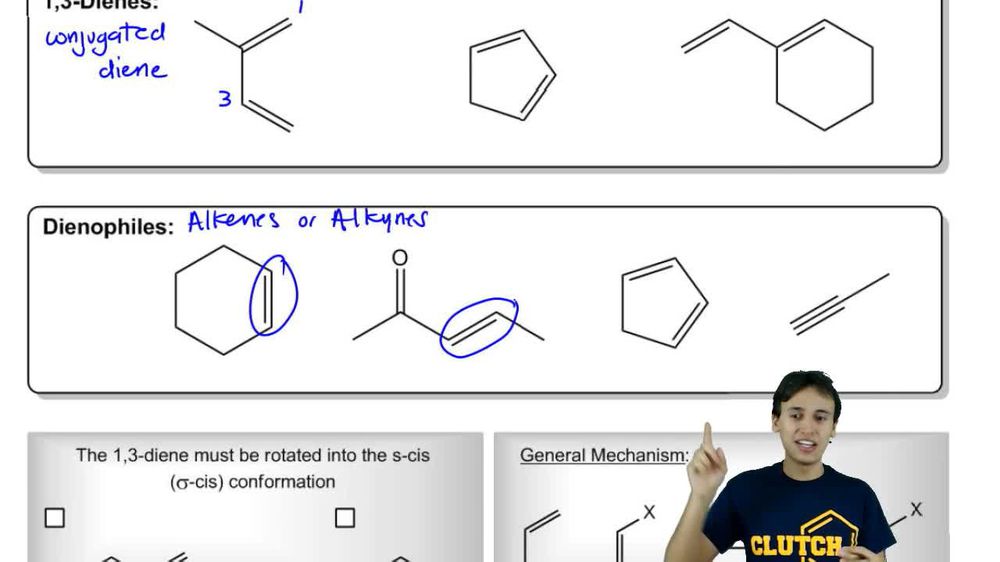
The Diels–Alder reaction is a [4+2] cycloaddition reaction between a conjugated diene and a dienophile, resulting in the formation of a six-membered ring. This reaction is a key method in organic synthesis for constructing cyclic compounds and is characterized by its stereospecificity and regioselectivity, making it a powerful tool for chemists.
Dienes are organic compounds that contain two double bonds. They can be classified as conjugated, where the double bonds are separated by a single bond, or isolated, where the double bonds are separated by more than one single bond. Conjugated dienes are particularly important in Diels–Alder reactions due to their ability to stabilize the transition state and facilitate the cycloaddition process.
Dienophiles are compounds that contain a double or triple bond and can react with dienes in the Diels–Alder reaction. They are typically electron-deficient, which enhances their reactivity towards the electron-rich diene. Common examples include alkenes and alkynes, often substituted with electron-withdrawing groups to increase their reactivity in the cycloaddition process.

 4:43 minutes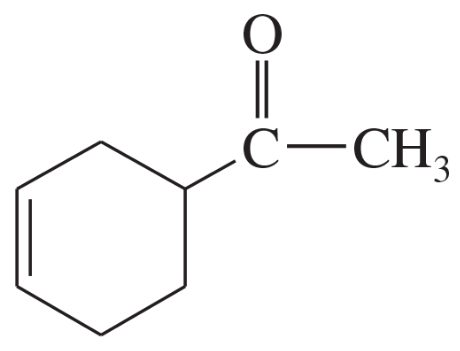
 Verified step by step guidance
 04:02
04:02