Give five examples of structures with this formula (C6H12). At least one should contain a ring, and at least one should contain a double bond. Hint: If you prefer to use a formula, elements of unsaturation = 1/2(2C + 2 - H) C = number of carbons H = number of hydrogens
Verified step by step guidance
1
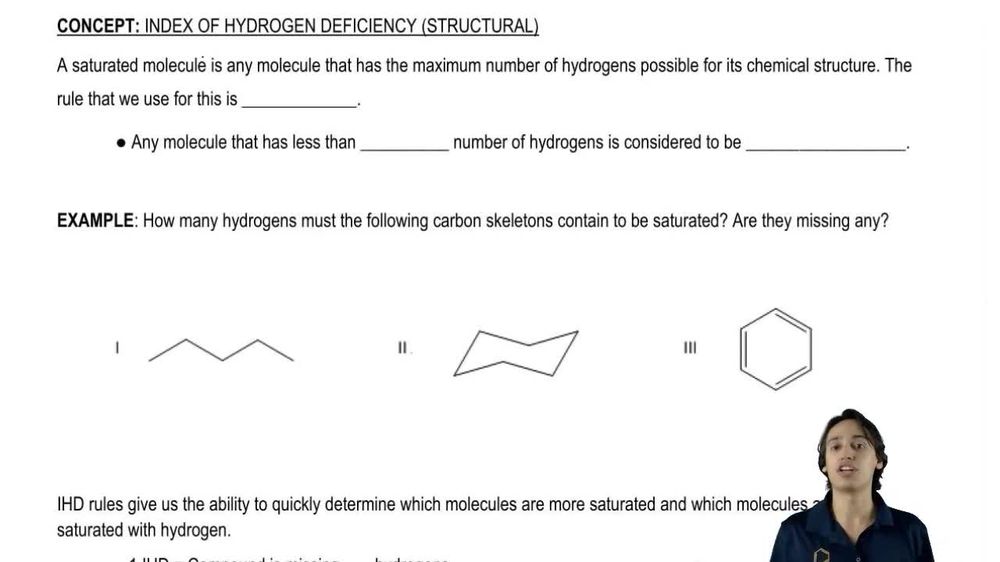
Step 1: Calculate the elements of unsaturation for the formula C6H12 using the formula: . Substitute C = 6 and H = 12 into the formula to find the degree of unsaturation.
Step 2: Understand that the degree of unsaturation indicates the number of rings or double bonds in the structure. A degree of unsaturation of 1 means there is either one ring or one double bond.
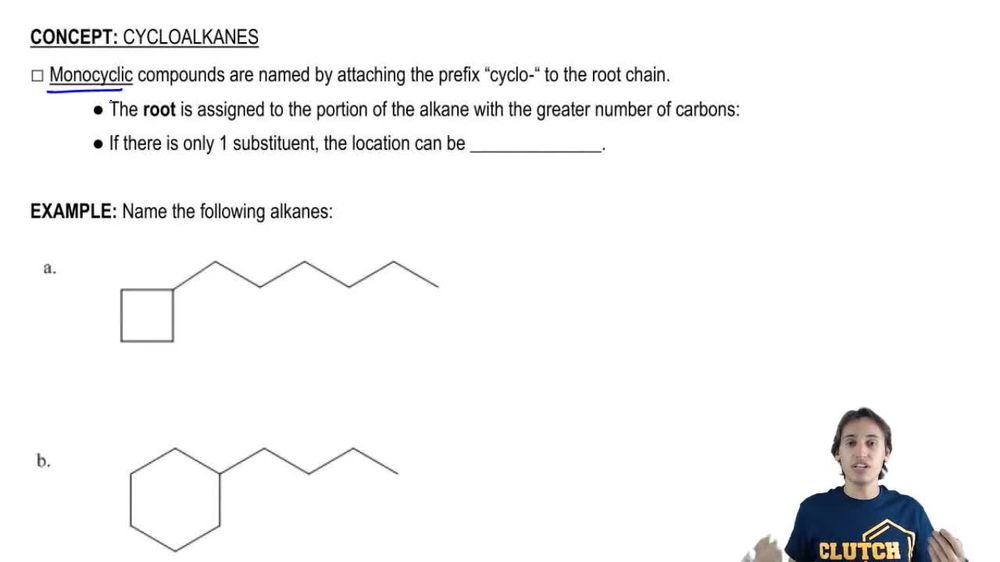
Step 3: Create a structure with a ring. Cyclohexane is a common example, which is a six-membered ring with no double bonds. This satisfies the formula C6H12.
Step 4: Create a structure with a double bond. Hexene is an example, where the double bond can be placed between any two carbon atoms in the chain, such as 1-hexene or 2-hexene.
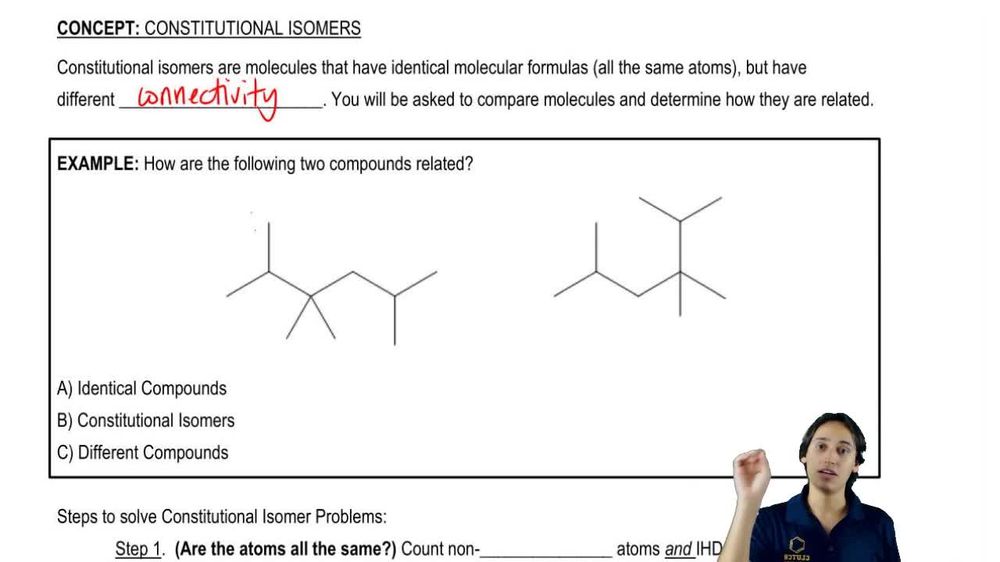
Step 5: Explore other structures that fit the formula C6H12. Consider variations like methylcyclopentane (a five-membered ring with a methyl group) or 3-methylpentene (a linear chain with a double bond and a methyl group).
Verified video answer for a similar problem:
This video solution was recommended by our tutors as helpful for the problem above
Video duration:
3m
Play a video:
0 Comments
Key Concepts
Here are the essential concepts you must grasp in order to answer the question correctly.
Molecular Formula and Structural Isomers
The molecular formula C6H12 indicates a compound with six carbon atoms and twelve hydrogen atoms. Understanding structural isomers is crucial, as these compounds can have different arrangements of atoms, leading to distinct structures with the same formula. Isomers can include linear chains, branched chains, rings, and those with double bonds, affecting the compound's properties.
Elements of unsaturation refer to the presence of pi bonds or rings in a molecule, which reduce the number of hydrogen atoms compared to a saturated hydrocarbon. The formula 1/2(2C + 2 - H) calculates the degree of unsaturation, helping identify the presence of double bonds or rings. For C6H12, the degree of unsaturation is one, indicating either one double bond or one ring.
The difference between saturated and unsaturated molecules.
Cycloalkanes and Alkenes
Cycloalkanes are hydrocarbons containing carbon atoms arranged in a ring, while alkenes are hydrocarbons with at least one carbon-carbon double bond. Both types of compounds can be derived from C6H12, with cyclohexane as a ring example and hexene as a double bond example. Understanding these structures is essential for identifying possible isomers of C6H12 that meet the question's criteria.

 3:36 minutes
 Verified step by step guidance
 01:10
01:10