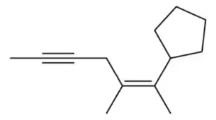
Calculate the index of hydrogen deficiency for the following molecules. (c)
Verified step by step guidance
1
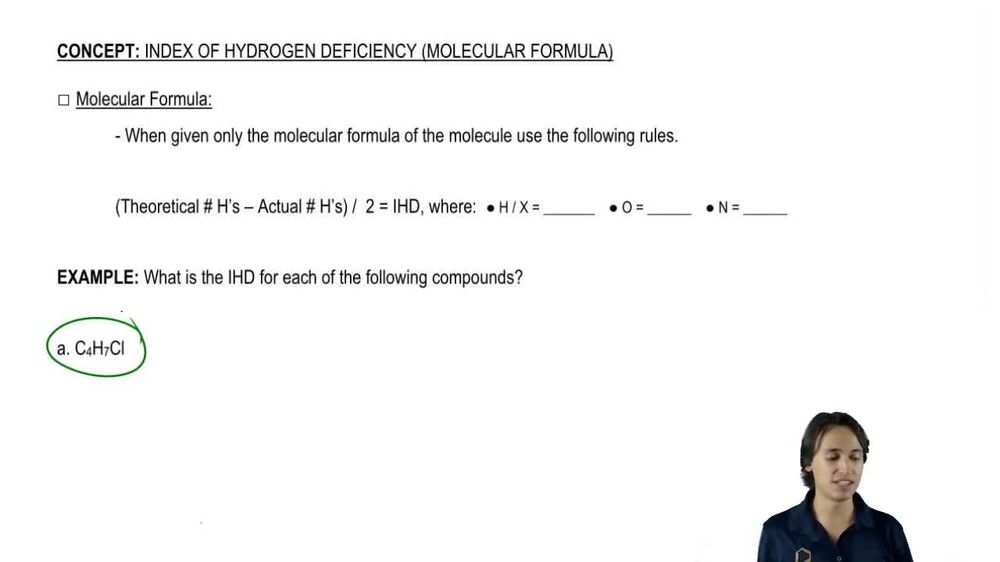
Step 1: Understand the concept of Index of Hydrogen Deficiency (IHD). IHD is a measure of the number of degrees of unsaturation in a molecule. Each degree of unsaturation corresponds to either a double bond, a ring, or a triple bond. The formula for IHD is: IHD = (2C + 2 - H + N - X)/2, where C is the number of carbons, H is the number of hydrogens, N is the number of nitrogens, and X is the number of halogens.
Step 2: Count the number of carbons (C) in the molecule. From the structure provided, count all the carbon atoms in the molecule, including those in the rings and chains.
Step 3: Count the number of hydrogens (H) in the molecule. This includes all hydrogens attached to the carbons in the structure. Note that implicit hydrogens are not shown in the skeletal structure but must be accounted for based on the valency of carbon.
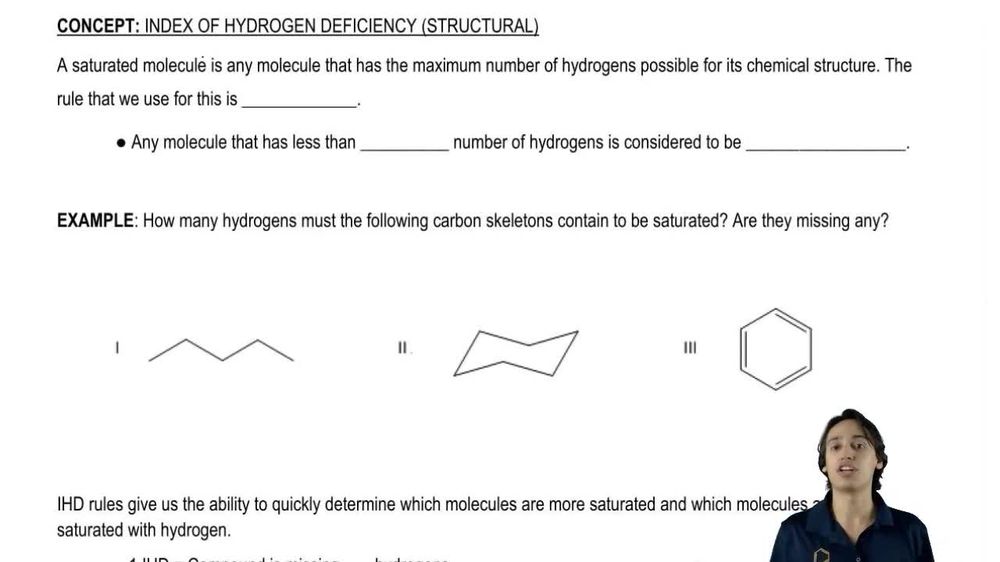
Step 4: Identify the degrees of unsaturation in the molecule. Look for double bonds, triple bonds, and rings in the structure. Each double bond and ring contributes 1 degree of unsaturation, while each triple bond contributes 2 degrees of unsaturation.
Step 5: Plug the values into the IHD formula. Use the counts of carbons, hydrogens, and any other relevant atoms (if applicable) to calculate the IHD. Simplify the formula to determine the number of degrees of unsaturation in the molecule.
Verified video answer for a similar problem:
This video solution was recommended by our tutors as helpful for the problem above
Play a video:
0 Comments
Key Concepts
Here are the essential concepts you must grasp in order to answer the question correctly.
Index of Hydrogen Deficiency (IHD)
The Index of Hydrogen Deficiency (IHD) is a measure used in organic chemistry to determine the degree of unsaturation in a molecule. It indicates the number of rings and/or multiple bonds present. The formula for calculating IHD is IHD = (2C + 2 + N - H - X) / 2, where C is the number of carbons, N is the number of nitrogens, H is the number of hydrogens, and X is the number of halogens.
The molecular formula of a compound provides the exact number of each type of atom in a molecule. It is essential for calculating the IHD, as it directly influences the values of C, H, N, and X in the IHD formula. Understanding how to derive the molecular formula from a structural representation is crucial for accurately determining the IHD.
Unsaturation refers to the presence of double or triple bonds in a molecule, as well as rings. Each degree of unsaturation corresponds to a loss of hydrogen atoms compared to a saturated hydrocarbon. Recognizing unsaturation is vital for interpreting the IHD, as it helps predict the reactivity and stability of organic compounds.

 Verified step by step guidance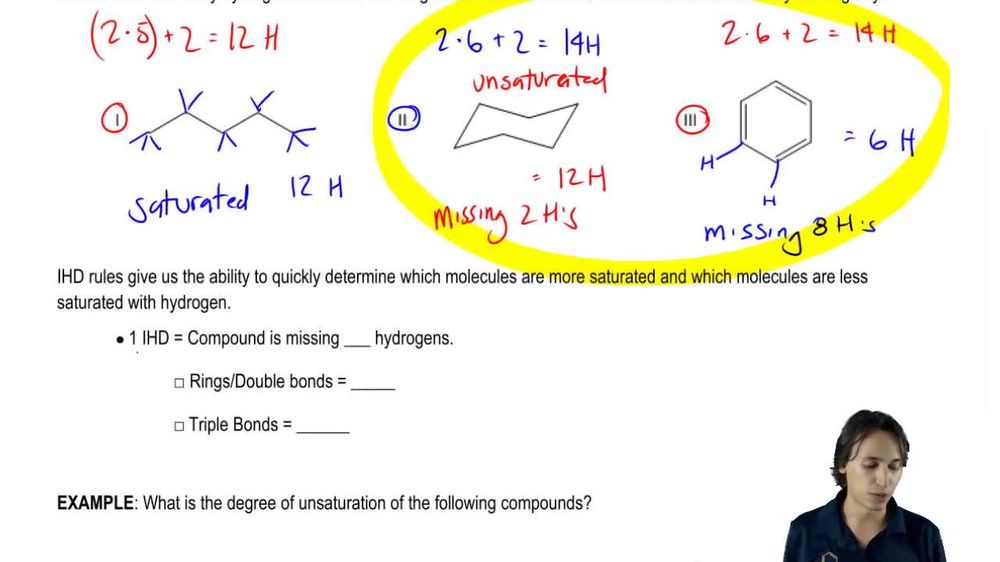
 01:15
01:15