Cytosine, uracil, and guanine have tautomeric forms with aromatic hydroxy groups. Draw these tautomeric forms.
Verified step by step guidance
1
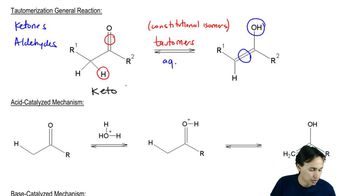
Understand the concept of tautomerism: Tautomerism is a type of isomerism where compounds exist in two interconvertible forms that differ in the position of a proton and the double bond. For cytosine, uracil, and guanine, the tautomeric forms involve keto-enol tautomerism, where a keto group (C=O) can convert to an enol group (-OH attached to a double-bonded carbon).
Identify the structure of cytosine: Cytosine is a pyrimidine base with an amino group (-NH2) at position 4 and a keto group (C=O) at position 2. The tautomeric form involves the migration of a proton from the amino group to the oxygen of the keto group, forming an enol group (-OH) at position 2.
Identify the structure of uracil: Uracil is a pyrimidine base with keto groups at positions 2 and 4. The tautomeric form involves the migration of a proton from one of the adjacent nitrogen atoms to the oxygen of a keto group, forming an enol group (-OH) at either position 2 or 4.
Identify the structure of guanine: Guanine is a purine base with a keto group at position 6 and an amino group at position 2. The tautomeric form involves the migration of a proton from the amino group to the oxygen of the keto group, forming an enol group (-OH) at position 6.
Draw the tautomeric forms: For each compound (cytosine, uracil, and guanine), redraw the structure to show the enol form. Ensure that the double bonds and proton positions are adjusted accordingly to reflect the tautomeric shift. Use proper resonance structures to depict aromaticity where applicable.
Verified video answer for a similar problem:
This video solution was recommended by our tutors as helpful for the problem above
Play a video:
0 Comments
Key Concepts
Here are the essential concepts you must grasp in order to answer the question correctly.
Tautomerism
Tautomerism is a chemical phenomenon where compounds exist in two or more interconvertible forms, typically differing in the position of a proton and a double bond. This is particularly relevant in organic chemistry, as it can affect the reactivity and properties of molecules. In nucleobases like cytosine, uracil, and guanine, tautomeric forms can influence hydrogen bonding and base pairing in nucleic acids.
Aromatic hydroxy groups are functional groups that consist of a hydroxyl (-OH) group attached to an aromatic ring. These groups are significant in organic compounds because they can participate in hydrogen bonding and influence the stability and reactivity of the molecule. In the context of nucleobases, the presence of hydroxy groups can lead to different tautomeric forms that are crucial for their biological functions.
Nucleobases, such as cytosine, uracil, and guanine, are the building blocks of nucleic acids like DNA and RNA. Their structure includes a nitrogenous base, which can exist in various tautomeric forms, affecting their pairing and stability. Understanding the structural features of these bases, including the positions of functional groups, is essential for drawing their tautomeric forms and comprehending their roles in genetic information.