Explain why a racemic mixture is formed when (R)-2-methylpentanal is dissolved in an acidic or basicsolution.
Verified step by step guidance
1
Identify the chiral center in (R)-2-methylpentanal, which is the carbon atom bonded to four different groups.
Understand that in acidic or basic solutions, the carbonyl group in 2-methylpentanal can undergo keto-enol tautomerism, forming an enol intermediate.
Recognize that the enol form is planar around the sp2 hybridized carbon, allowing for the possibility of re-protonation from either side of the plane.
Realize that re-protonation of the enol can lead to the formation of either the (R) or (S) enantiomer, as the planar intermediate does not favor one side over the other.
Conclude that the equal probability of forming either enantiomer results in a racemic mixture, which is a 1:1 mixture of the (R) and (S) enantiomers.
Verified video answer for a similar problem:
This video solution was recommended by our tutors as helpful for the problem above
Video duration:
6m
Play a video:
0 Comments
Key Concepts
Here are the essential concepts you must grasp in order to answer the question correctly.
Racemic Mixture
A racemic mixture consists of equal amounts of two enantiomers, which are molecules that are mirror images of each other. In organic chemistry, racemic mixtures often arise during reactions involving chiral centers, where the reaction can lead to the formation of both enantiomers without preference. This results in a 50:50 mixture, which is optically inactive because the optical activities of the two enantiomers cancel each other out.
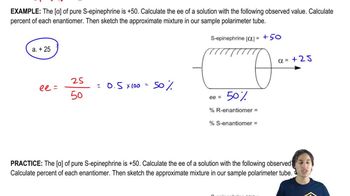
Calculating EE, percent of each enantiomer, and sketching mixture
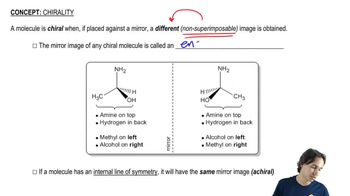
Chirality and Enantiomers
Chirality refers to the property of a molecule that makes it non-superimposable on its mirror image, typically due to the presence of a chiral center, such as a carbon atom bonded to four different substituents. Enantiomers are the two distinct forms of a chiral molecule, each capable of rotating plane-polarized light in opposite directions. The formation of a racemic mixture indicates that both enantiomers are produced during a reaction, often due to the lack of a chiral influence in the reaction environment.
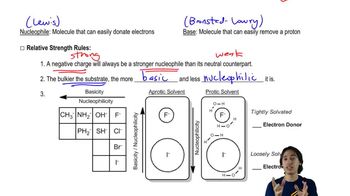
Acidic and basic conditions can significantly influence the reactivity and stability of organic compounds. In the case of (R)-2-methylpentanal, the presence of an acid or base can facilitate the formation of a carbocation or anionic intermediate, which can then lead to the attack by nucleophiles from either side of the chiral center. This non-selective attack results in the formation of both enantiomers, contributing to the racemic mixture observed in the solution.

 6:52 minutes
 Verified step by step guidance
 03:08
03:08