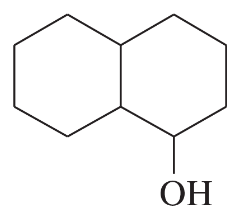
Show how you would make the following compounds from a suitable cyclic alkene. (e)
Verified step by step guidance
1
Step 1: Identify the cyclic alkene that can serve as the starting material. In this case, cyclooctene (an eight-membered ring with one double bond) is a suitable choice because it can undergo regioselective addition reactions.
Step 2: Perform hydroboration-oxidation to introduce the hydroxyl (-OH) group at the desired position. Hydroboration involves the addition of BH₃ (borane) to the double bond in an anti-Markovnikov fashion, followed by oxidation with H₂O₂ (hydrogen peroxide) in a basic solution (NaOH). This reaction ensures the hydroxyl group is added to the less substituted carbon of the double bond.
Step 3: Ensure stereochemistry is correct. Hydroboration-oxidation typically results in syn addition, meaning the hydrogen and hydroxyl group will add to the same face of the ring. This is important for maintaining the correct stereochemistry of the product.
Step 4: Verify the product structure. After the reaction, the hydroxyl group should be attached to the carbon adjacent to the original double bond, forming the desired compound with the correct ring size and functional group placement.
Step 5: Purify the product using standard organic chemistry techniques such as distillation or recrystallization, depending on the physical properties of the compound, to ensure the final compound is free of impurities.
Verified video answer for a similar problem:
This video solution was recommended by our tutors as helpful for the problem above
Video duration:
7m
Play a video:
0 Comments
Key Concepts
Here are the essential concepts you must grasp in order to answer the question correctly.
Cyclic Alkenes
Cyclic alkenes are hydrocarbons that contain a carbon ring with at least one double bond. They are important in organic synthesis as they can undergo various reactions, such as hydrogenation, halogenation, and ring-opening reactions, to form different compounds. Understanding the structure and reactivity of cyclic alkenes is crucial for designing synthetic pathways to target molecules.
Alkenes can participate in a variety of chemical reactions due to the presence of the double bond, which is reactive. Common reactions include electrophilic addition, where reagents add across the double bond, and polymerization. Knowledge of these reactions is essential for transforming cyclic alkenes into desired products, such as alcohols or other functional groups.
Functional group interconversion refers to the process of transforming one functional group into another through chemical reactions. In the context of organic synthesis, this concept is vital for modifying cyclic alkenes into alcohols, as seen in the provided compound. Understanding the mechanisms and reagents involved in these transformations allows chemists to effectively design synthetic routes to complex molecules.