Show how you would accomplish the following transformations. (b)
Verified step by step guidance
1
Analyze the starting material: The structure is a bicyclic compound with a double bond in one of the rings. This suggests that the reaction will involve the addition of a functional group to the double bond.
Determine the target molecule: The product is a bicyclic compound with an alcohol (-OH) group added to the ring system. This indicates that the reaction involves a hydration process.
Select the appropriate reaction: To add an -OH group to the double bond, use an acid-catalyzed hydration reaction. This typically involves using water (H₂O) in the presence of a strong acid, such as H₂SO₄, to protonate the double bond and form a carbocation intermediate.
Consider regioselectivity: The Markovnikov rule applies here, meaning the -OH group will add to the more substituted carbon of the double bond, as this stabilizes the carbocation intermediate.
Propose the mechanism: (1) Protonate the double bond using H⁺ to form a carbocation intermediate. (2) Add water (H₂O) to the carbocation to form an oxonium ion. (3) Deprotonate the oxonium ion to yield the final alcohol product.
Verified video answer for a similar problem:
This video solution was recommended by our tutors as helpful for the problem above
Video duration:
4m
Play a video:
0 Comments
Key Concepts
Here are the essential concepts you must grasp in order to answer the question correctly.
Nucleophilic Addition
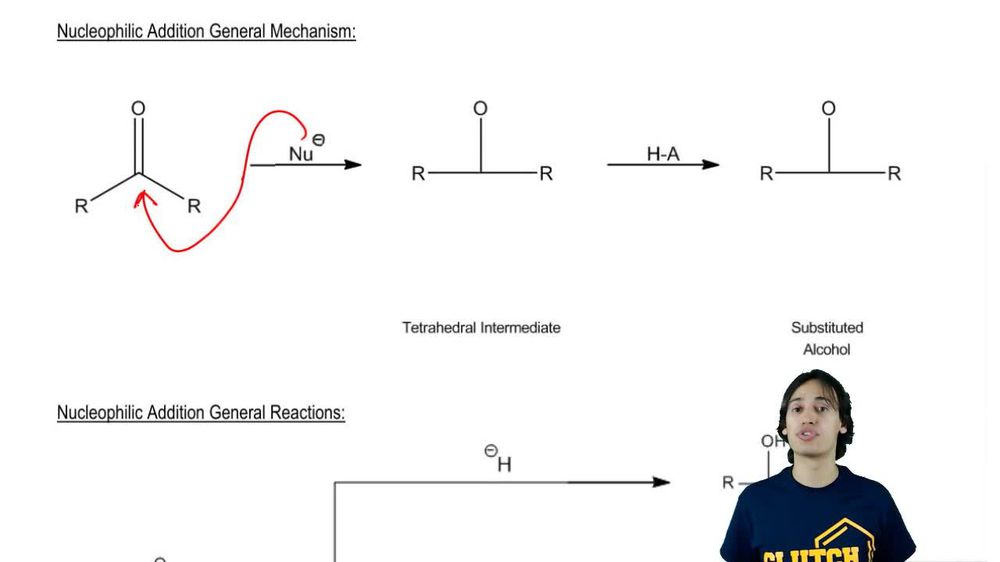
Nucleophilic addition is a fundamental reaction mechanism in organic chemistry where a nucleophile attacks an electrophilic carbon atom, leading to the formation of a new bond. In the context of the transformation shown, a nucleophile, such as water or an alcohol, can add to a double bond or a carbonyl group, resulting in the formation of an alcohol. Understanding this mechanism is crucial for predicting the products of reactions involving unsaturated compounds.
Stereochemistry refers to the study of the spatial arrangement of atoms in molecules and how this affects their chemical behavior. In the transformation depicted, the stereochemistry of the starting material can influence the outcome of the reaction, particularly if the reaction involves chiral centers. Recognizing the stereochemical implications is essential for determining the correct product and understanding the reaction pathway.
Functional group transformation involves the conversion of one functional group into another through chemical reactions. In the given transformation, a double bond in a bicyclic compound is converted into an alcohol functional group. Mastery of functional group transformations is vital for organic synthesis, as it allows chemists to manipulate molecules to achieve desired properties and reactivity.

 4:35 minutes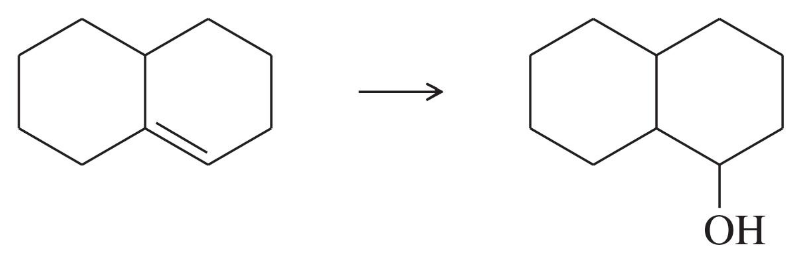
 Verified step by step guidance
 08:27
08:27