Predict the product(s) that would result when the alkenes shown here are allowed to react under the following conditions: (vi) 1. BH3 2. H2O2, NaOH (g)
Verified step by step guidance
1
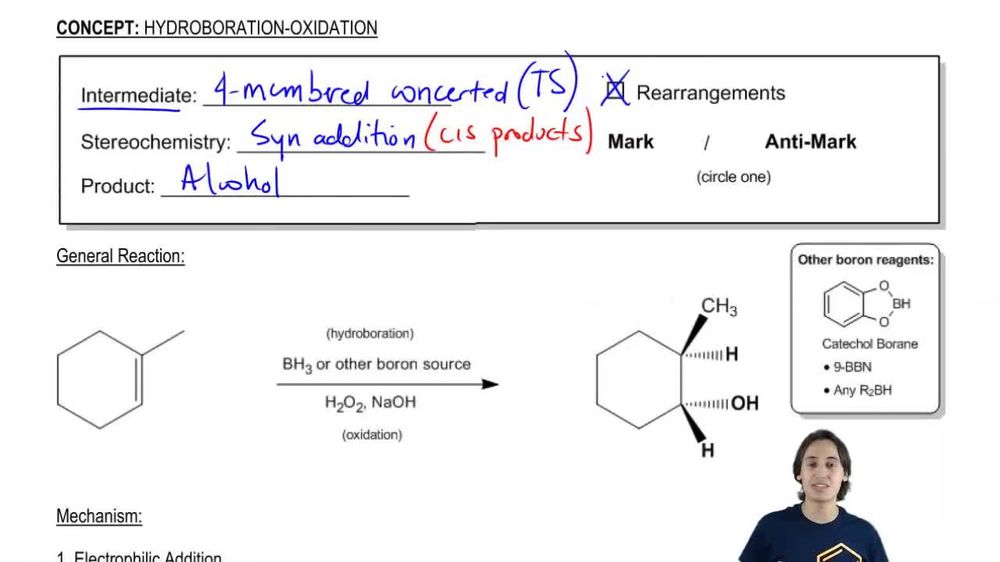
Identify the reaction type: The given reagents (1. BH₃, 2. H₂O₂, NaOH) indicate a hydroboration-oxidation reaction. This reaction is used to convert an alkene into an alcohol.
Understand the regioselectivity: Hydroboration-oxidation follows anti-Markovnikov addition, meaning the hydroxyl group (-OH) will attach to the less substituted carbon of the double bond.
Understand the stereochemistry: The addition of BH₃ occurs in a syn fashion, meaning both the boron and hydrogen add to the same side of the alkene. This stereochemistry is retained during the oxidation step, resulting in a syn addition of the hydroxyl group and hydrogen.
Apply the reaction to the given alkene: Identify the double bond in the alkene structure and determine which carbon is less substituted. Attach the hydroxyl group (-OH) to the less substituted carbon and a hydrogen atom to the more substituted carbon.
Draw the product: After determining the regioselectivity and stereochemistry, draw the final product, ensuring the hydroxyl group is on the less substituted carbon and the stereochemistry reflects syn addition.
Verified video answer for a similar problem:
This video solution was recommended by our tutors as helpful for the problem above
Video duration:
3m
Play a video:
0 Comments
Key Concepts
Here are the essential concepts you must grasp in order to answer the question correctly.
Hydroboration-Oxidation
Hydroboration-oxidation is a two-step reaction process used to convert alkenes into alcohols. In the first step, borane (BH₃) adds across the double bond of the alkene, resulting in a trialkylborane intermediate. The second step involves oxidation with hydrogen peroxide (H₂O₂) in the presence of a base (NaOH), which converts the boron atom into a hydroxyl group, yielding an alcohol.
Regioselectivity refers to the preference of a chemical reaction to yield one structural isomer over others when multiple products are possible. In hydroboration, the addition of borane occurs in a syn manner, favoring the formation of the less substituted alcohol due to the anti-Markovnikov rule, where the hydroxyl group ends up on the less substituted carbon of the alkene.
Stereochemistry is the study of the spatial arrangement of atoms in molecules and how this affects their chemical behavior. In the hydroboration-oxidation process, the syn addition of BH₃ leads to specific stereochemical outcomes in the final alcohol product, which can influence the reactivity and properties of the resulting compound.

 3:37 minutes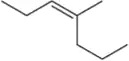
 Verified step by step guidance
 06:38
06:38