Compound A, with molecular formula C4H9Cl, shows two signals in its 13C NMR spectrum. Compound B, an isomer of compound A, shows four signals, and in the proton-coupled mode, the signal farthest downfield is a doublet. Identify compounds A and B.
Verified step by step guidance
1
Analyze the molecular formula C4H9Cl: This indicates that the compound contains 4 carbons, 9 hydrogens, and 1 chlorine atom. The presence of chlorine suggests the compound is an alkyl halide.
Interpret the 13C NMR data for Compound A: The fact that Compound A shows only two signals in its 13C NMR spectrum implies that it has symmetry, reducing the number of unique carbon environments to two.
Interpret the 13C NMR data for Compound B: Compound B, being an isomer of Compound A, also has the formula C4H9Cl. However, it shows four signals in its 13C NMR spectrum, indicating that all four carbons are in unique environments, meaning it lacks symmetry.
Analyze the proton-coupled 13C NMR data for Compound B: The signal farthest downfield being a doublet suggests that one of the carbons is directly bonded to a single hydrogen atom. This is characteristic of a carbon attached to a chlorine atom (due to the electronegativity of chlorine causing deshielding) and having one hydrogen.
Propose structures for A and B: Based on the symmetry and NMR data, Compound A is likely a symmetrical alkyl chloride, such as tert-butyl chloride (2-chloro-2-methylpropane), which has two unique carbon environments. Compound B, with four unique carbon environments and a downfield doublet, is likely 1-chlorobutane, where the carbon bonded to chlorine has one hydrogen and is deshielded.
Verified video answer for a similar problem:
This video solution was recommended by our tutors as helpful for the problem above
Video duration:
6m
Play a video:
0 Comments
Key Concepts
Here are the essential concepts you must grasp in order to answer the question correctly.
NMR Spectroscopy
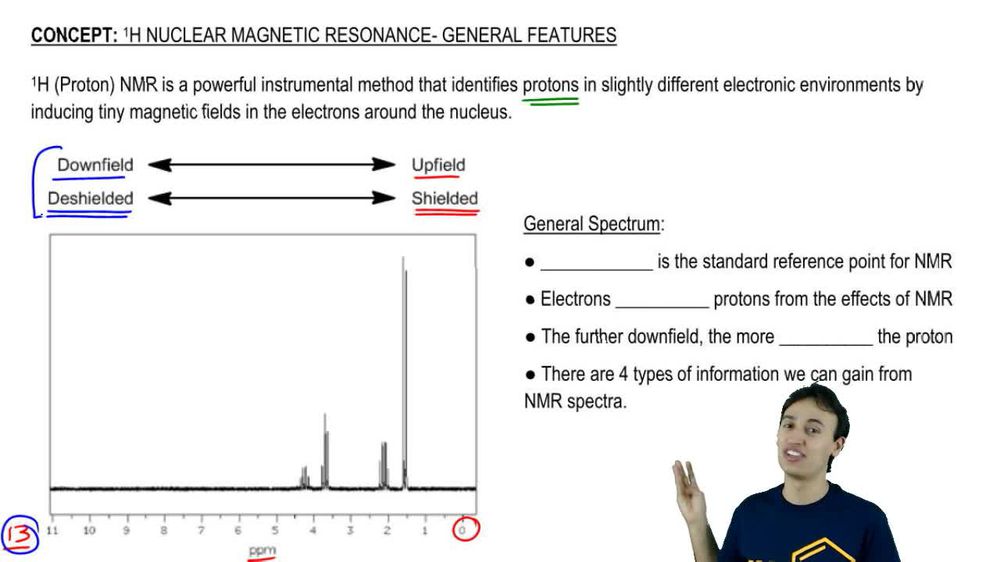
Nuclear Magnetic Resonance (NMR) spectroscopy is a powerful analytical technique used to determine the structure of organic compounds. It provides information about the number of unique carbon environments in a molecule, as indicated by the number of signals in the 13C NMR spectrum. The position and splitting of these signals can reveal details about the molecular structure, including functional groups and connectivity.
Isomerism refers to the phenomenon where two or more compounds have the same molecular formula but different structural arrangements or spatial orientations. In this case, compound A and compound B are isomers of each other, meaning they share the same formula (C4H9Cl) but differ in their connectivity or arrangement of atoms, leading to distinct NMR spectral characteristics.
In NMR spectroscopy, signal splitting occurs due to the interaction between neighboring hydrogen atoms, known as spin-spin coupling. This results in the appearance of multiple peaks for a single signal, which can provide insight into the number of adjacent protons. For example, a doublet indicates that a proton is coupled to one neighboring proton, which is crucial for deducing the structure of compound B in the given question.

 6:14 minutes
 Verified step by step guidance
 10:06
10:06