How can 1,2-, 1,3-, and 1,4-dinitrobenzene be distinguished by b. 13C NMR spectroscopy?
Verified step by step guidance
1
Understand the concept: In 13C NMR spectroscopy, the chemical environment of each carbon atom in a molecule determines its chemical shift. The symmetry and electronic effects of substituents on the benzene ring will influence the number of unique carbon signals observed in the spectrum.
Analyze 1,2-dinitrobenzene (ortho isomer): This molecule has two nitro groups (-NO₂) attached to adjacent carbons on the benzene ring. Due to the lack of symmetry, all six carbons in the ring are in different chemical environments, resulting in six distinct signals in the 13C NMR spectrum.
Analyze 1,3-dinitrobenzene (meta isomer): In this isomer, the nitro groups are attached to carbons separated by one carbon. The molecule has a plane of symmetry passing through the carbon atoms between the nitro groups. This symmetry reduces the number of unique carbon environments to four, so the 13C NMR spectrum will show four distinct signals.
Analyze 1,4-dinitrobenzene (para isomer): Here, the nitro groups are attached to carbons opposite each other on the benzene ring. The molecule has a high degree of symmetry, with a plane of symmetry and rotational symmetry. This results in only three unique carbon environments, so the 13C NMR spectrum will show three distinct signals.
Compare the spectra: By counting the number of distinct signals in the 13C NMR spectra, you can distinguish between the three isomers. 1,2-dinitrobenzene will have six signals, 1,3-dinitrobenzene will have four signals, and 1,4-dinitrobenzene will have three signals.
Verified video answer for a similar problem:
This video solution was recommended by our tutors as helpful for the problem above
Video duration:
5m
Play a video:
0 Comments
Key Concepts
Here are the essential concepts you must grasp in order to answer the question correctly.
NMR Spectroscopy
Nuclear Magnetic Resonance (NMR) spectroscopy is a powerful analytical technique used to determine the structure of organic compounds. It exploits the magnetic properties of certain nuclei, such as carbon-13 (13C), to provide information about the environment surrounding these nuclei. In 13C NMR, the chemical shifts observed are influenced by the electronic environment, allowing for differentiation between various carbon atoms in a molecule.
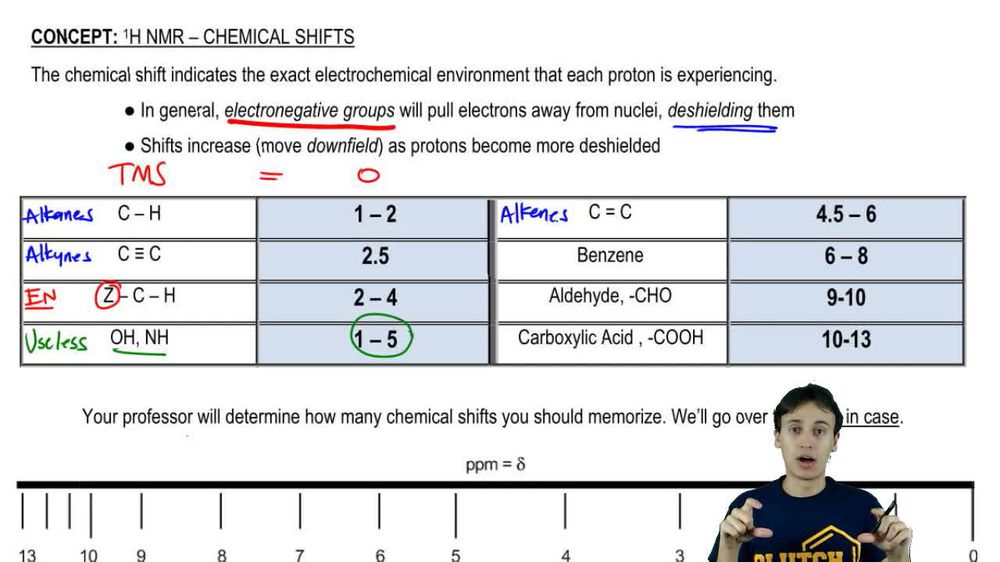
Chemical shifts in NMR spectroscopy refer to the variation in resonance frequency of a nucleus due to its electronic environment. In 13C NMR, different substituents on the benzene ring, such as nitro groups, can cause shifts in the carbon signals. The position and number of these substituents in 1,2-, 1,3-, and 1,4-dinitrobenzene will lead to distinct chemical shifts, enabling their differentiation based on the resulting spectra.
The symmetry and substitution patterns of a molecule significantly influence its NMR spectrum. In the case of dinitrobenzenes, the positions of the nitro groups (ortho, meta, and para) affect the symmetry of the molecule, which in turn impacts the number of unique carbon environments. This results in different peak patterns and intensities in the 13C NMR spectrum, allowing for the identification of each isomer based on their distinct substitution patterns.

 5:07 minutes
 Verified step by step guidance
 10:06
10:06