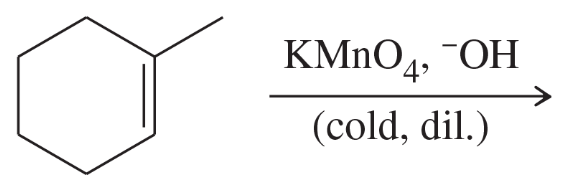
Predict the major products of the following reactions, and give the structures of any intermediates. Include stereochemistry where appropriate. (i)
Verified step by step guidance
1
Step 1: Analyze the reaction conditions. The reagents KMnO₄ (cold, dilute) and NaOH (aq) indicate that this is a reaction involving oxidative cleavage or hydroxylation of alkenes under mild conditions.
Step 2: Identify the functional group in the starting material. The molecule contains a cyclopentene ring, which has a double bond (alkene). This is the reactive site for KMnO₄.
Step 3: Predict the intermediate. Under cold, dilute KMnO₄ conditions, the alkene undergoes syn-dihydroxylation, forming a cis-1,2-diol intermediate. The stereochemistry of the diol will be syn (both hydroxyl groups added to the same face of the double bond).
Step 4: Consider the final product. Since the reaction does not involve strong oxidative conditions (e.g., hot KMnO₄ or acidic medium), the diol remains intact and does not undergo further cleavage or oxidation.
Step 5: Draw the major product. The major product will be a cyclopentane ring with hydroxyl groups (-OH) attached to the carbons that were part of the double bond, in a syn configuration. Ensure stereochemistry is clearly indicated in the structure.
Verified video answer for a similar problem:
This video solution was recommended by our tutors as helpful for the problem above
Video duration:
7m
Play a video:
0 Comments
Key Concepts
Here are the essential concepts you must grasp in order to answer the question correctly.
Dihydroxylation
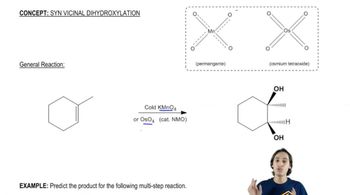
Dihydroxylation is a chemical reaction that involves the addition of two hydroxyl (–OH) groups across a double bond in an alkene. This reaction can be achieved through various reagents, with potassium permanganate (KMnO4) being a common choice. The reaction typically proceeds via a cyclic intermediate, leading to the formation of vicinal diols, which are compounds with hydroxyl groups on adjacent carbon atoms.
General properties of syn vicinal dihydroxylation.
Stereochemistry
Stereochemistry refers to the study of the spatial arrangement of atoms in molecules and how this affects their chemical behavior. In reactions like dihydroxylation, the stereochemistry of the product is crucial, as the orientation of the hydroxyl groups can lead to different isomers. Understanding stereochemistry helps predict the configuration of the products, which is essential for accurately representing the reaction outcomes.
The oxidation state of a molecule indicates the degree of oxidation of its atoms, which is important in redox reactions. In the context of the reaction with KMnO4, the manganese in KMnO4 is reduced while the alkene is oxidized to form diols. Understanding the mechanism of this reaction, including the role of hydroxide ions from NaOH, is essential for predicting the products and intermediates formed during the reaction.