Ch. 8 - Delocalized Electrons: Their Effect on Stability, pKa, and the Products of a Reaction • Aromaticity and Electronic Effects: An Introduction to the Reactions of Benzene
Bruice - Organic Chemistry 8th Edition
Bruice8th EditionOrganic ChemistryISBN: 9780135213711Not the one you use?Change textbook
Chapter 9, Problem 48a

Which of the following are aromatic?
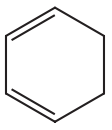
a. A hexagonal structure representing an aromatic hydrocarbon with alternating double bonds.
b. Diagram illustrating aromatic hydrocarbons with labeled options for identification.
c. Diagram showing a rectangular structure with two vertical lines, representing aromatic hydrocarbons.

Verified step by step guidance
1
Step 1: Recall the criteria for aromaticity. A molecule is aromatic if it satisfies the following conditions: (1) It is cyclic, (2) It is planar, (3) It has a conjugated π-electron system, and (4) It follows Huckel's rule, which states that the molecule must have (4n + 2) π-electrons, where n is a non-negative integer.
Step 2: Analyze structure A. Structure A is a five-membered ring with two double bonds and a positive charge. Count the π-electrons: each double bond contributes 2 π-electrons, so there are 4 π-electrons. The positive charge does not contribute any π-electrons. Check if it satisfies Huckel's rule (4n + 2 = 6 π-electrons). Since it does not, structure A is not aromatic.
Step 3: Analyze structure B. Structure B is a six-membered ring with three double bonds. Count the π-electrons: each double bond contributes 2 π-electrons, so there are 6 π-electrons. Check if it satisfies Huckel's rule (4n + 2 = 6 π-electrons). Since it does, structure B is aromatic.
Step 4: Analyze structure C. Structure C is a five-membered ring with two double bonds and a negative charge. Count the π-electrons: each double bond contributes 2 π-electrons, and the negative charge contributes 2 π-electrons, so there are 6 π-electrons. Check if it satisfies Huckel's rule (4n + 2 = 6 π-electrons). Since it does, structure C is aromatic.
Step 5: Summarize the findings. Structure B and structure C are aromatic, while structure A is not aromatic.

Verified video answer for a similar problem:

This video solution was recommended by our tutors as helpful for the problem above.
Video duration:
5m
Was this helpful?

Key Concepts

Here are the essential concepts you must grasp in order to answer the question correctly.

Aromaticity

Aromaticity is a property of cyclic compounds that exhibit enhanced stability due to resonance. For a compound to be considered aromatic, it must be cyclic, planar, and follow Hückel's rule, which states that it must have a total of 4n + 2 π electrons, where n is a non-negative integer. This unique electron configuration allows for delocalization, contributing to the compound's stability.
Recommended video:
Guided course
08:19
Intro to Aromaticity

Hückel's Rule

Hückel's Rule is a criterion used to determine the aromaticity of a compound. It states that a planar, cyclic molecule is aromatic if it contains 4n + 2 π electrons in its conjugated system, where n is an integer (0, 1, 2, ...). This rule helps in identifying which compounds can exhibit aromatic characteristics based on their electron count.
Recommended video:
Guided course
03:54
The 18 and 16 Electron Rule

Planarity and Conjugation

For a compound to be aromatic, it must be both planar and have a continuous overlap of p-orbitals, allowing for conjugation. Planarity ensures that the π electrons can delocalize across the entire ring structure, while conjugation refers to the alternating single and double bonds that facilitate this electron delocalization. Without these features, a compound cannot achieve the stability associated with aromaticity.
Recommended video:
Guided course
03:27
Conjugated states