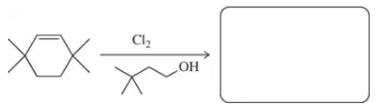
In light of your answer to Assessment 9.47, predict the product of the following reactions we have seen previously where an alcohol is substituted for water. (c)
Verified step by step guidance
1
Step 1: Analyze the reactants. The first reactant is a bicyclohexane structure with two methyl groups attached. The second reactant is chlorine gas (Cl₂) in the presence of an alcohol solvent (2-methyl-2-butanol). This suggests a substitution or addition reaction involving chlorine.
Step 2: Consider the role of the alcohol solvent. Alcohols can act as nucleophiles or solvents that stabilize intermediates. In this case, the alcohol is likely to participate in the reaction as a solvent, influencing the reaction pathway.
Step 3: Predict the reaction mechanism. Chlorine gas (Cl₂) typically undergoes homolytic cleavage under light or heat to form chlorine radicals. These radicals can initiate a radical substitution reaction, especially at the most reactive hydrogen positions in the bicyclohexane structure.
Step 4: Identify the most reactive hydrogen positions. In the bicyclohexane structure, the hydrogens on the bridgehead carbons are less reactive due to steric hindrance. The hydrogens on the methyl groups are more accessible and likely to be substituted by chlorine radicals.
Step 5: Predict the product. The chlorine radical will replace one of the hydrogens on the methyl groups, forming a chlorinated bicyclohexane derivative. The alcohol solvent stabilizes the reaction intermediates but does not directly participate in the substitution.
Verified video answer for a similar problem:
This video solution was recommended by our tutors as helpful for the problem above
Play a video:
0 Comments
Key Concepts
Here are the essential concepts you must grasp in order to answer the question correctly.
Electrophilic Aromatic Substitution
Electrophilic aromatic substitution (EAS) is a fundamental reaction in organic chemistry where an electrophile replaces a hydrogen atom on an aromatic ring. In this process, the aromatic system donates electrons to the electrophile, forming a sigma complex, which then loses a proton to restore aromaticity. Understanding EAS is crucial for predicting the products of reactions involving aromatic compounds, such as the one presented in the question.
In organic reactions, alcohols can act as nucleophiles due to the presence of a lone pair of electrons on the oxygen atom. This property allows alcohols to participate in substitution reactions, where they can replace leaving groups like water. Recognizing the role of alcohols in nucleophilic substitution is essential for predicting the outcome of the reaction shown in the question.
Halogenation involves the introduction of halogen atoms (like chlorine) into an organic molecule, often through EAS mechanisms. In the presence of a halogen and a catalyst, aromatic compounds can undergo substitution reactions where a hydrogen atom is replaced by a halogen. Understanding the conditions and mechanisms of halogenation is vital for predicting the products of the reaction depicted in the question.

 Verified step by step guidance
 03:07
03:07