Using the bond-dissociation energies in Table 5.6, (a) predict whether or not a fluorine radical would be selective for forming a single radical from propane.
Verified step by step guidance
1
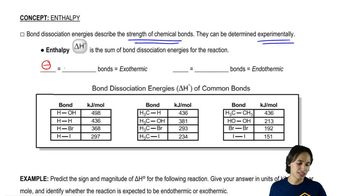
Understand the concept of bond-dissociation energy: Bond-dissociation energy is the energy required to break a bond in a molecule, resulting in the formation of radicals. It is a measure of the bond strength.
Identify the relevant bond-dissociation energies: Look up the bond-dissociation energies for the C-H bonds in propane and the C-H bonds in the potential radical products. This will help determine which bond is most likely to be broken by the fluorine radical.
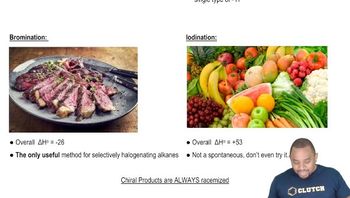
Consider the reactivity of fluorine radicals: Fluorine radicals are highly reactive due to their high electronegativity and small size. They tend to react quickly and may not be very selective in their reactions.
Compare the bond-dissociation energies: Analyze the bond-dissociation energies of the primary and secondary C-H bonds in propane. Typically, secondary C-H bonds have lower bond-dissociation energies compared to primary C-H bonds, making them more likely to be broken.
Predict the selectivity: Based on the bond-dissociation energies and the reactivity of fluorine radicals, predict whether the fluorine radical will preferentially form a single radical from propane or if it will react non-selectively with multiple C-H bonds.
Verified video answer for a similar problem:
This video solution was recommended by our tutors as helpful for the problem above
Video duration:
7m
Play a video:
0 Comments
Key Concepts
Here are the essential concepts you must grasp in order to answer the question correctly.
Bond-Dissociation Energy
Bond-dissociation energy is the energy required to break a bond in a molecule, resulting in the formation of radicals. It is a measure of bond strength and varies depending on the atoms involved and the molecular environment. Understanding these energies helps predict the stability of radicals formed during chemical reactions.
How to calculate enthalpy using bond dissociation energies.
Radical Selectivity
Radical selectivity refers to the preference of a radical to react with certain types of bonds over others. This selectivity is influenced by factors such as bond-dissociation energies and steric effects. In the context of fluorine radicals, their high reactivity can lead to less selectivity, making it crucial to analyze bond energies to predict reaction outcomes.
Propane is a three-carbon alkane with the molecular formula C3H8. It consists of primary and secondary hydrogen atoms, which differ in their bond-dissociation energies. Understanding the structure of propane is essential for predicting which hydrogen atoms are more likely to be abstracted by a radical, influencing the formation of specific radicals.