For each alkane, which monobrominated derivatives could you form in good yield by free-radical bromination? a. Cyclopentane b. Methylcyclopentnae
Verified step by step guidance
1
Identify the structure of the given alkanes: Cyclopentane is a cyclic alkane with five carbon atoms in a ring, and Methylcyclopentane is a cyclopentane ring with a single methyl group attached to one of the carbons.
Understand the concept of free-radical bromination: Bromination occurs at the most stable radical intermediate, which is determined by the stability of the carbon radical formed during the reaction. Radical stability follows the order: tertiary > secondary > primary > methyl.
For Cyclopentane: All hydrogens in cyclopentane are equivalent because of the symmetry of the molecule. Bromination at any carbon will yield the same product, 1-bromocyclopentane.
For Methylcyclopentane: The hydrogens are not equivalent due to the presence of the methyl group. Identify the different types of hydrogens: (1) Hydrogens on the methyl group (primary hydrogens), (2) Hydrogens on the carbon adjacent to the methyl group (secondary hydrogens), and (3) Hydrogens on the other carbons in the ring (secondary hydrogens). Bromination will preferentially occur at the secondary carbon adjacent to the methyl group because it forms the most stable radical.
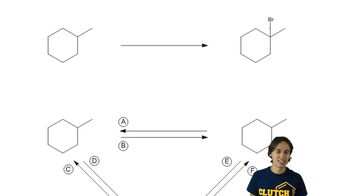
Conclude the products: For Cyclopentane, the product is 1-bromocyclopentane. For Methylcyclopentane, the major product is bromination at the secondary carbon adjacent to the methyl group, forming 1-bromo-2-methylcyclopentane. Minor products may form from bromination at other secondary or primary positions, but these are less favored.
Verified video answer for a similar problem:
This video solution was recommended by our tutors as helpful for the problem above
Video duration:
3m
Play a video:
0 Comments
Key Concepts
Here are the essential concepts you must grasp in order to answer the question correctly.
Free-Radical Bromination
Free-radical bromination is a reaction mechanism where bromine (Br2) reacts with alkanes in the presence of heat or light to form brominated products. This process involves the generation of bromine radicals, which abstract hydrogen atoms from the alkane, leading to the formation of alkyl radicals. These alkyl radicals can then react with bromine molecules to yield monobrominated derivatives. The selectivity of this reaction is influenced by the stability of the resulting radicals.
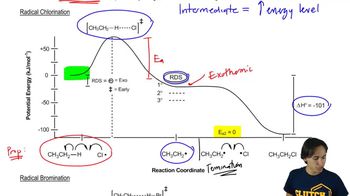
Using the Hammond Postulate to describe radical bromination.
Alkane Structure and Reactivity
Alkanes are saturated hydrocarbons characterized by single carbon-carbon bonds. Their reactivity in free-radical bromination depends on the structure of the alkane, including the presence of branching and cyclic structures. For example, cyclopentane and methylcyclopentane have different reactivity patterns due to their unique structures, which affect the stability of the radicals formed during bromination. Understanding these structural features is crucial for predicting the products of the reaction.
Monobrominated derivatives are organic compounds formed when one hydrogen atom in an alkane is replaced by a bromine atom. The formation of these derivatives during free-radical bromination can lead to multiple products, especially in branched or cyclic alkanes, due to the presence of different hydrogen environments. Identifying the possible monobrominated products requires analyzing the alkane's structure and the positions where bromination can occur, which is essential for understanding the yields of the reaction.