Show how you would accomplish the following synthetic transformations. Show all intermediates. i. hex-1-yne → hexanal, CH3(CH2)4CHO
Verified step by step guidance
1
Step 1: Analyze the transformation. The starting material is hex-1-yne, an alkyne, and the product is hexanal, an aldehyde. This indicates that the triple bond in hex-1-yne must be converted into a single bond, and the terminal carbon must be oxidized to form the aldehyde functional group.
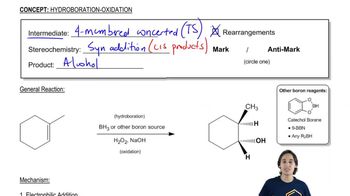
Step 2: Select the appropriate reaction. To convert a terminal alkyne into an aldehyde, hydroboration-oxidation is a suitable method. This involves two steps: (a) hydroboration using a reagent like disiamylborane (R2BH) or 9-BBN, and (b) oxidation using hydrogen peroxide (H2O2) in a basic solution (NaOH).
Step 3: Perform hydroboration. Add disiamylborane (R2BH) to hex-1-yne. The boron atom selectively adds to the less substituted carbon of the triple bond, forming an organoborane intermediate.
Step 4: Oxidize the organoborane intermediate. Treat the organoborane with hydrogen peroxide (H2O2) in the presence of a base (NaOH). This step converts the boron-attached carbon into an aldehyde group, yielding hexanal.
Step 5: Verify the product. The final product is hexanal, CH3(CH2)4CHO, which matches the desired transformation. Ensure all intermediates and reagents are accounted for in the mechanism.
Verified video answer for a similar problem:
This video solution was recommended by our tutors as helpful for the problem above
Video duration:
7m
Play a video:
0 Comments
Key Concepts
Here are the essential concepts you must grasp in order to answer the question correctly.
Alkyne Hydroboration-Oxidation
This reaction involves the addition of borane (BH3) to an alkyne, followed by oxidation with hydrogen peroxide (H2O2) in the presence of a base. For hex-1-yne, this process converts the terminal alkyne into an aldehyde, specifically hexanal, by forming a trialkyl borane intermediate that is subsequently oxidized.
Markovnikov's Rule states that in the addition of HX to an alkene or alkyne, the hydrogen atom will attach to the carbon with the greater number of hydrogen atoms already attached. This principle is crucial in predicting the formation of intermediates during the hydroboration of hex-1-yne, leading to the correct regioselectivity in the final product, hexanal.
Understanding synthetic pathways involves recognizing the sequence of reactions and intermediates that lead from a starting material to a desired product. In this case, identifying the intermediates formed during the hydroboration and subsequent oxidation steps is essential for illustrating the transformation of hex-1-yne to hexanal.