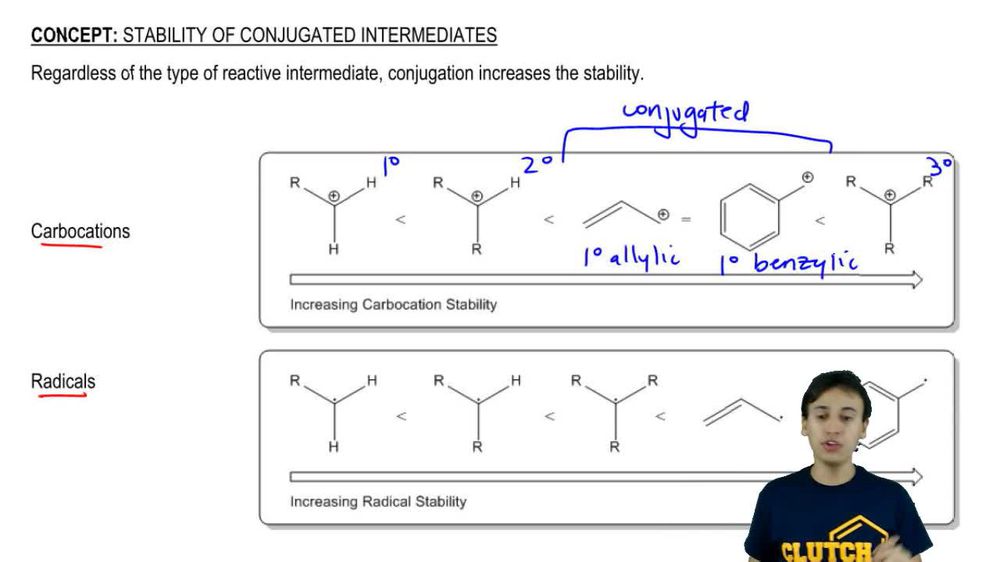
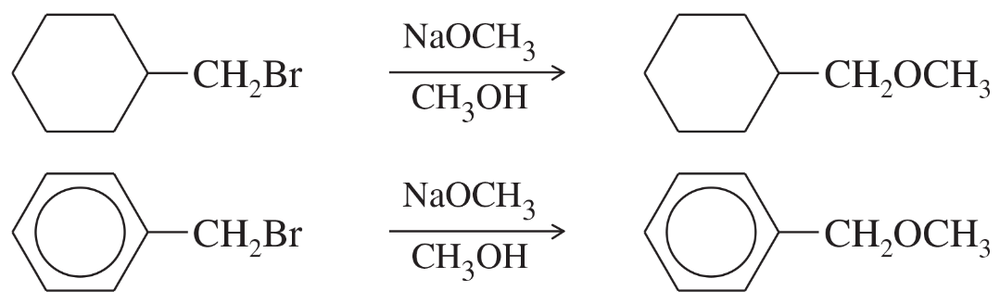
The benzene ring alters the reactivity of a neighboring group in the benzylic position much as a double bond alters the reactivity of groups in the allylic position. Benzylic cations, anions, and radicals are all more stable than simple alkyl intermediates. c. Which of the following reactions will have the faster rate and give the better yield? Use a drawing of the transition state to explain your answer.
Verified step by step guidance
1
Step 1: Analyze the two reactions provided. Reaction (i) involves a cyclohexyl group with a CH2Cl substituent, while reaction (ii) involves a benzyl group with a CH2Cl substituent. Both reactions proceed via nucleophilic substitution using NaOCH2CH3 in ethanol as the nucleophile and solvent.
Step 2: Consider the stability of the intermediate formed during the reaction. In reaction (ii), the benzyl group stabilizes the intermediate (whether cation, anion, or radical) due to resonance with the aromatic ring. This stabilization is absent in reaction (i), where the cyclohexyl group does not provide resonance stabilization.
Step 3: Draw the transition states for both reactions. For reaction (ii), the transition state will show partial resonance stabilization of the benzylic intermediate, while for reaction (i), the transition state lacks such stabilization. This difference impacts the activation energy of the reactions.
Step 4: Compare the rates of the reactions. The resonance stabilization in reaction (ii) lowers the activation energy, making the reaction faster compared to reaction (i). Additionally, the benzyl group enhances the yield due to the increased stability of the intermediate.
Step 5: Conclude that reaction (ii) will have a faster rate and better yield due to the stabilizing effect of the benzyl group in the benzylic position, which is supported by resonance stabilization in the transition state.
Verified video answer for a similar problem:
This video solution was recommended by our tutors as helpful for the problem above
Video duration:
10m
Play a video:
0 Comments
Key Concepts
Here are the essential concepts you must grasp in order to answer the question correctly.
Benzylic Position
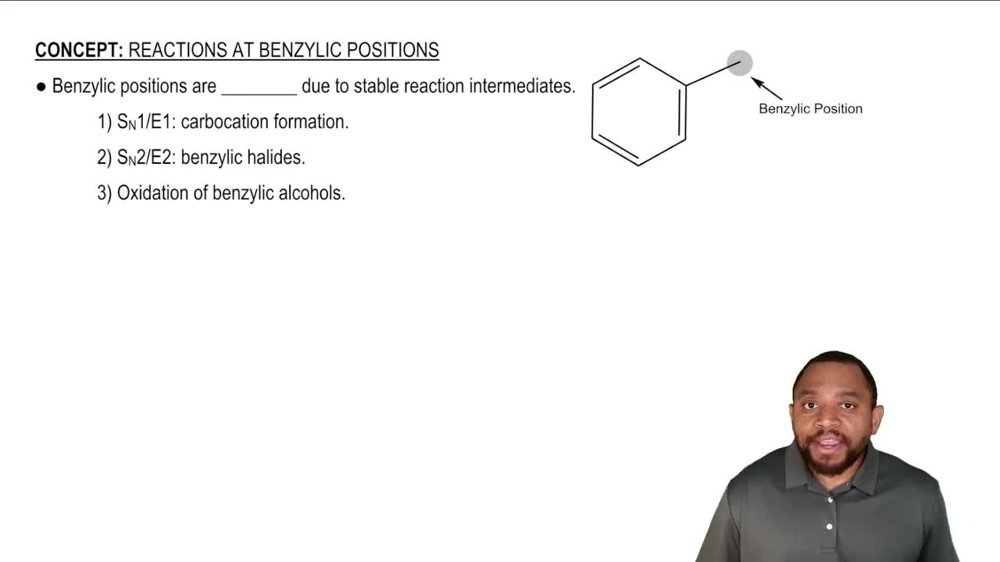
The benzylic position refers to the carbon atom directly attached to a benzene ring. This position is significant because it exhibits unique reactivity patterns due to the resonance stabilization provided by the aromatic system. Reactions involving benzylic intermediates, such as cations, anions, and radicals, tend to be more favorable compared to those involving simple alkyl groups, leading to increased stability and reactivity.
In organic chemistry, the stability of reaction intermediates like cations, anions, and radicals is crucial for predicting reaction rates and outcomes. Benzylic cations, anions, and radicals are more stable than their non-aromatic counterparts due to resonance stabilization, which allows for delocalization of charge. This increased stability often results in faster reaction rates and better yields in reactions involving benzylic intermediates.
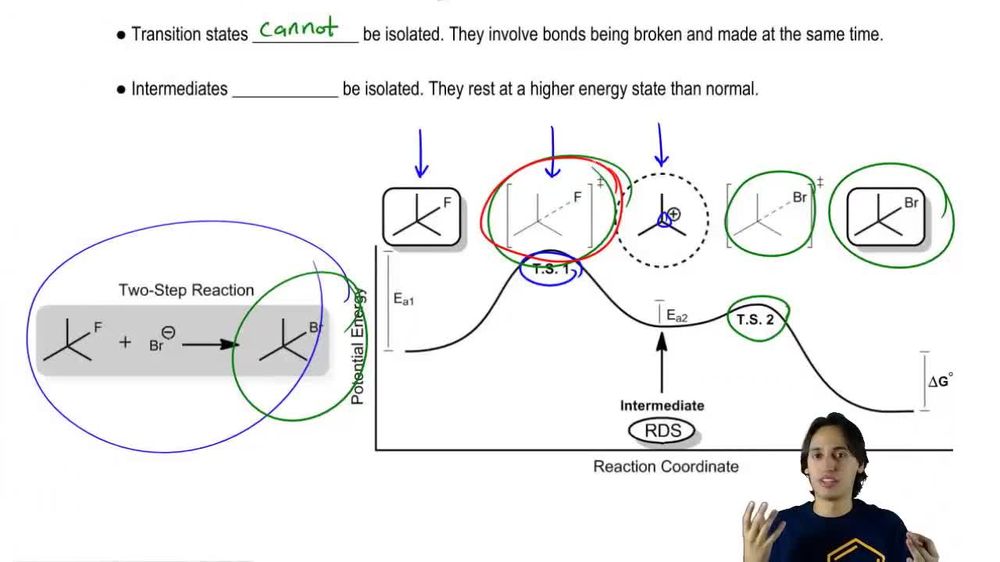
Transition state theory describes the high-energy state that occurs during a chemical reaction, where reactants are transformed into products. The transition state is a critical point along the reaction pathway and determines the rate of the reaction. Understanding the structure of the transition state, especially in reactions involving benzylic positions, can provide insights into the reaction mechanism and help predict which reaction will proceed faster or yield better results.

 10:08 minutes
 Verified step by step guidance
 1:01
1:01