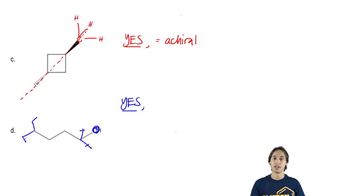
For each Fischer projection, 1. make a model. 2. draw the mirror 3.. determine whether the mirror is the same as, or different from, the original structure. 4. draw any mirror planes of symmetry that are apparent from the Fischer projections. (c) (d)
Verified step by step guidance
1
Step 1: For each Fischer projection (c and d), identify the groups attached to the central carbon atoms and their spatial arrangement. Fischer projections represent molecules in a 2D format, with horizontal lines indicating bonds projecting out of the plane (toward the viewer) and vertical lines indicating bonds projecting into the plane (away from the viewer).
Step 2: Draw the mirror image of each Fischer projection. To do this, reflect the structure across a vertical mirror plane. For example, for (c), the CH2Br group on top and CH3 group on the bottom remain in the same positions, but the Br groups on the horizontal axis switch sides. Similarly, for (d), reflect all groups across the vertical axis.
Step 3: Compare the original structure with its mirror image to determine if they are superimposable. If the original structure and its mirror image are identical, the molecule is achiral. If they are not superimposable, the molecule is chiral.
Step 4: Identify any planes of symmetry in the Fischer projections. A plane of symmetry divides a molecule into two mirror-image halves. For example, in (c), check if there is a plane of symmetry passing through the central carbon atom. For (d), analyze the arrangement of groups to determine if a plane of symmetry exists.
Step 5: Summarize the findings for each structure. For (c), determine if the molecule is chiral or achiral based on the presence or absence of a plane of symmetry and the comparison with its mirror image. Repeat the same analysis for (d).
Verified video answer for a similar problem:
This video solution was recommended by our tutors as helpful for the problem above
Video duration:
3m
Play a video:
0 Comments
Key Concepts
Here are the essential concepts you must grasp in order to answer the question correctly.
Fischer Projections
Fischer projections are a two-dimensional representation of three-dimensional organic molecules, particularly useful for depicting stereochemistry. In these projections, vertical lines represent bonds that extend away from the viewer, while horizontal lines represent bonds that come towards the viewer. This format is especially important for visualizing the configuration of chiral centers in carbohydrates and amino acids.
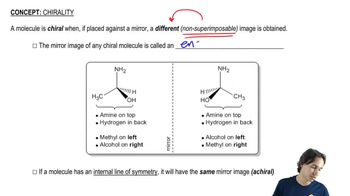
Chirality refers to the property of a molecule that makes it non-superimposable on its mirror image, akin to how left and right hands are mirror images but not identical. Molecules that exhibit chirality often exist as pairs of enantiomers, which are stereoisomers that are mirror images of each other. Understanding chirality is crucial for predicting the behavior of molecules in biological systems, as enantiomers can have vastly different effects.
Symmetry in organic molecules can be analyzed through the concept of mirror planes, which are hypothetical planes that divide a molecule into two mirror-image halves. Identifying mirror planes helps determine whether a molecule is chiral or achiral. A molecule with a plane of symmetry is typically achiral, while the absence of such a plane indicates chirality, which is essential for understanding the stereochemical properties of the molecule.

 3:21 minutes

 Verified step by step guidance

 09:56
09:56