
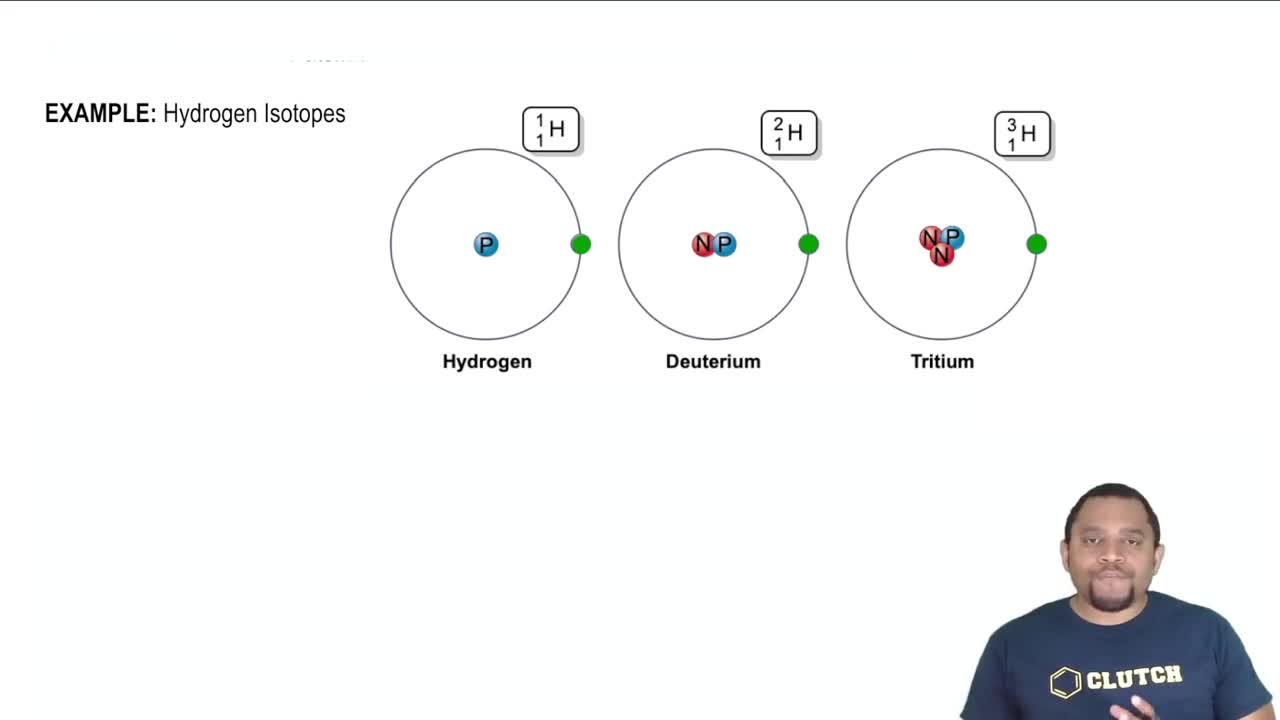

Deuterium (D) is the hydrogen isotope of mass number 2, with a proton and a neutron in its nucleus. The chemistry of deuterium is nearly identical to the chemistry of hydrogen, except that the C―D bond is slightly stronger than the C―H bond by 5.0 kJ/mol (1.2 kcal/mol). Reaction rates tend to be slower when a C―D bond (as opposed to a C―H bond) is broken in a rate-limiting step.This effect, called a kinetic isotope effect, is clearly seen in the chlorination of methane. Methane undergoes free-radical chlorination 12 times as fast as tetradeuteriomethane (CD4)Faster: CH4 + Cl⋅ —> CH3Cl + HCl relative rate= 12Slower: CD4 + Cl⋅ —> CD3Cl + DClrelative rate= 1 c. Consider the thermodynamics of the chlorination of methane and the chlorination of ethane, and use the Hammond postulate to explain why one of these reactions has a much larger isotope effect than the other.
Verified step by step guidance
1
Identify the reactions involved: chlorination of methane (CH4) and chlorination of ethane (C2H6).
Understand the Hammond postulate: It states that the transition state of a reaction resembles the structure of the closest stable species. For exothermic reactions, the transition state is closer to the reactants, while for endothermic reactions, it is closer to the products.
Consider the bond dissociation energies: The C-H bond in methane is stronger than in ethane, making the transition state for methane chlorination more reactant-like, according to the Hammond postulate.
Analyze the kinetic isotope effect: The stronger C-D bond in CD4 compared to C-H in CH4 leads to a larger kinetic isotope effect in reactions where the transition state is more reactant-like, such as in methane chlorination.
Conclude that the larger isotope effect in methane chlorination compared to ethane chlorination is due to the transition state being more reactant-like, making the difference in bond strength between C-H and C-D more significant.
Verified video answer for a similar problem:
This video solution was recommended by our tutors as helpful for the problem above
Video duration:
5m
Play a video:
0 Comments
Key Concepts
Here are the essential concepts you must grasp in order to answer the question correctly.
Kinetic Isotope Effect
The kinetic isotope effect (KIE) refers to the change in reaction rate that occurs when an atom in a molecule is replaced by one of its isotopes. In organic reactions, this effect is particularly pronounced when breaking bonds involving hydrogen isotopes, such as deuterium (D) and protium (H). The C―D bond is stronger than the C―H bond, leading to slower reaction rates when C―D bonds are involved in the rate-limiting step of a reaction.
The Hammond postulate states that the structure of the transition state of a reaction resembles the structure of the reactants or products to which it is closer in energy. This principle helps predict the effects of substituents on reaction rates and can explain why reactions involving different isotopes exhibit varying kinetic behaviors. In the context of chlorination, the postulate can elucidate why the transition state for the chlorination of methane differs significantly from that of ethane, affecting the isotope effect.
The thermodynamics of chlorination reactions involve the energy changes associated with bond breaking and formation during the reaction. The stability of the transition state and the energy of the products influence the overall reaction rate. In comparing the chlorination of methane and ethane, the differences in bond strengths and the resulting transition state energies can lead to a more pronounced kinetic isotope effect in one reaction over the other, as predicted by the Hammond postulate.