Identify the sugar in each description. c. A ketose that, when reduced with NaBH4, forms D-altritol and D-allitol.
Verified step by step guidance
1
Identify the type of sugar described in the problem. The sugar is a ketose, meaning it contains a ketone functional group (C=O) within its structure.
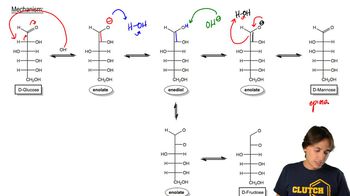
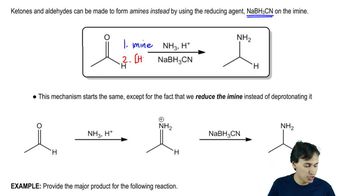
Understand the reduction process. When a ketose is reduced with NaBH4 (sodium borohydride), the ketone group is converted into a secondary alcohol, resulting in the formation of two different alditols (sugar alcohols) due to the creation of a new chiral center.
Analyze the products of the reduction. The problem states that the reduction of the ketose forms d-altritol and d-allitol. These two alditols are stereoisomers, differing in the configuration of their chiral centers.
Determine the ketose that can produce these two alditols. The ketose must have a structure such that reduction at the ketone group leads to the formation of d-altritol and d-allitol. This requires analyzing the stereochemistry of the ketose and its potential reduction products.
Conclude that the ketose in question is d-psicose. When d-psicose is reduced with NaBH4, it forms d-altritol and d-allitol due to the specific arrangement of its chiral centers and the resulting stereochemistry of the reduction products.
Verified video answer for a similar problem:
This video solution was recommended by our tutors as helpful for the problem above
Video duration:
6m
Play a video:
0 Comments
Key Concepts
Here are the essential concepts you must grasp in order to answer the question correctly.
Ketose
A ketose is a type of sugar (carbohydrate) that contains a ketone group (C=O) in its structure. Unlike aldoses, which have an aldehyde group, ketoses typically have their carbonyl group located at the second carbon atom. This structural difference influences their reactivity and the types of derivatives they can form during chemical reactions.
Reduction reactions involve the gain of electrons or hydrogen by a molecule, often resulting in the conversion of a carbonyl group (C=O) to an alcohol (C-OH). In the context of sugars, reducing agents like sodium borohydride (NaBH4) can convert ketoses into sugar alcohols, which are important in various biological and industrial processes.
Sugar alcohols, or polyols, are derived from sugars through reduction, where the carbonyl group is converted into a hydroxyl group. Examples include d-altritol and d-allitol, which are formed from specific ketoses. These compounds are often used as sweeteners and have applications in food and pharmaceutical industries due to their lower caloric content compared to regular sugars.