What monosaccharide is reduced to two alditols, one of which is the alditol obtained from the reduction of 1. D-talose? 2. D-allose?
Verified step by step guidance
1
Understand the problem: The question asks which monosaccharide, when reduced, produces two alditols. One of these alditols must match the alditol obtained from the reduction of D-talose, and the other must match the alditol obtained from the reduction of D-allose. Reduction of a monosaccharide typically involves converting the aldehyde or ketone group into an alcohol group, forming an alditol.
Step 1: Recall the structure of D-talose and D-allose. Both are aldohexoses (six-carbon sugars with an aldehyde group). D-talose and D-allose differ in their stereochemistry at specific chiral centers. Write out their Fischer projections to visualize their structures.
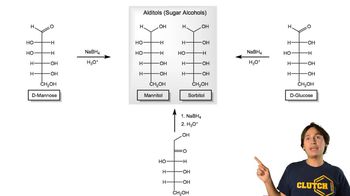
Step 2: Understand the reduction process. When an aldohexose undergoes reduction, the aldehyde group (−CHO) at the top of the Fischer projection is converted into a primary alcohol group (−CH₂OH). This process does not alter the stereochemistry of the other chiral centers in the molecule.
Step 3: Identify the alditols formed from the reduction of D-talose and D-allose. Reduce the aldehyde group in each sugar to a primary alcohol group and determine the resulting alditols. These alditols will have the same stereochemistry as the original sugars at all chiral centers.
Step 4: Determine the common precursor monosaccharide. The question implies that there is a single monosaccharide that, when reduced, produces two alditols: one matching the alditol from D-talose and the other matching the alditol from D-allose. This suggests that the precursor monosaccharide is an epimer of both D-talose and D-allose, differing in stereochemistry at one or more chiral centers. Compare the structures of D-talose and D-allose to identify the common precursor.
Verified video answer for a similar problem:
This video solution was recommended by our tutors as helpful for the problem above
Video duration:
5m
Play a video:
0 Comments
Key Concepts
Here are the essential concepts you must grasp in order to answer the question correctly.
Monosaccharides
Monosaccharides are the simplest form of carbohydrates, consisting of single sugar units. They serve as the building blocks for more complex carbohydrates and can exist in various forms, such as aldoses and ketoses. Understanding the structure and properties of monosaccharides is essential for grasping how they can be chemically modified, such as through reduction to form alditols.
Reduction of sugars involves the conversion of carbonyl groups (aldehydes or ketones) in monosaccharides to hydroxyl groups, resulting in the formation of alditols (sugar alcohols). This process is significant in organic chemistry as it alters the physical and chemical properties of the sugars, allowing for the study of their reactivity and potential applications in various fields, including food science and biochemistry.
Alditols, or sugar alcohols, are the reduced forms of monosaccharides where the carbonyl group has been converted to a hydroxyl group. They are important in both biological systems and industrial applications, often used as sweeteners or humectants. Identifying specific alditols derived from particular monosaccharides, such as d-talose and d-allose, is crucial for understanding their metabolic pathways and potential uses.