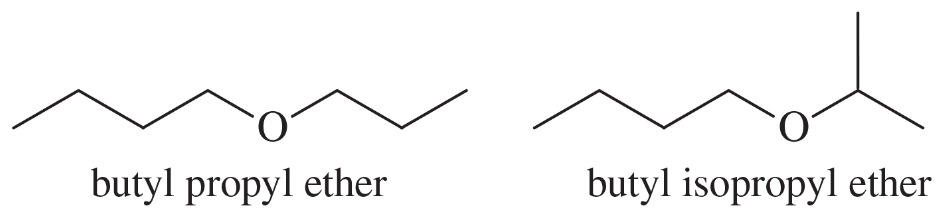
Ethers are not easily differentiated by their infrared spectra, but they tend to form predictable fragments in the mass spectrum. The following compounds give similar but distinctive mass spectra. Both compounds give prominent peaks at m/z 116, 73, 57, and 43. But one compound gives a distinctive strong peak at 87, and the other compound gives a strong peak at 101. Determine which compound gives the peak at 87 and which one gives the peak at 101. Propose fragmentations to account for the ions at m/z 116, 101, 87, and 73.
Verified step by step guidance
1
Step 1: Analyze the chemical structures provided in the image. The first compound is ethyl propyl ether (CH3CH2OCH2CH2CH3), and the second compound is methyl butyl ether (CH3OCH2CH2CH2CH3). Both are ethers, and their fragmentation patterns in mass spectrometry will depend on the cleavage of bonds around the oxygen atom.
Step 2: Understand the mass spectrum peaks. The m/z values correspond to the mass-to-charge ratio of fragments. Peaks at m/z 116, 73, 57, and 43 are common to both compounds, indicating similar fragmentation pathways. However, the distinctive peaks at m/z 87 and 101 will help differentiate the compounds.
Step 3: Propose fragmentation for m/z 116. This peak corresponds to the molecular ion of both compounds, representing the intact molecule without fragmentation. For ethyl propyl ether, the molecular ion is CH3CH2OCH2CH2CH3, and for methyl butyl ether, it is CH3OCH2CH2CH2CH3.
Step 4: Propose fragmentation for m/z 87 and m/z 101. The peak at m/z 87 is likely due to the loss of an ethyl group (CH3CH2) from ethyl propyl ether, forming CH3CH2OCH2+. The peak at m/z 101 is likely due to the loss of a methyl group (CH3) from methyl butyl ether, forming CH3OCH2CH2CH2+.
Step 5: Propose fragmentation for m/z 73. This peak is common to both compounds and likely corresponds to the loss of a propyl group (CH2CH2CH3) from ethyl propyl ether or a butyl group (CH2CH2CH2CH3) from methyl butyl ether, forming CH3OCH2+.
Verified video answer for a similar problem:
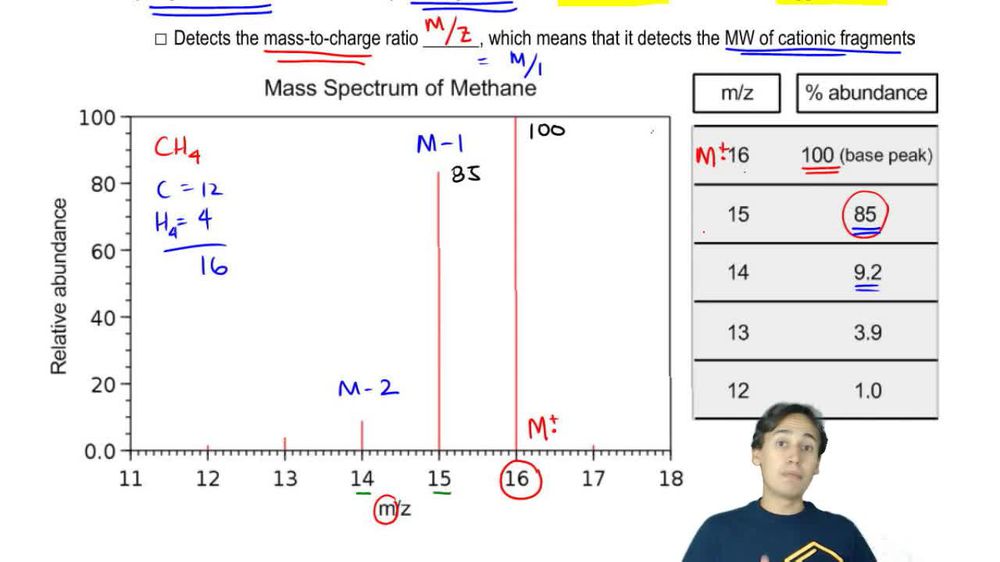
This video solution was recommended by our tutors as helpful for the problem above
Video duration:
4m
Play a video:
0 Comments
Key Concepts
Here are the essential concepts you must grasp in order to answer the question correctly.
Mass Spectrometry Fragmentation
Mass spectrometry fragmentation involves the breaking of chemical bonds in a molecule to produce smaller ions, which can be detected and analyzed. The pattern of these fragments provides insight into the structure of the original compound. Each compound has a unique fragmentation pattern based on its molecular structure, allowing for differentiation between similar compounds.
Infrared (IR) spectroscopy is a technique used to identify functional groups in organic compounds based on their vibrational transitions. However, ethers often exhibit similar IR spectra due to their structural similarities, making it challenging to distinguish between them using this method alone. This limitation necessitates the use of complementary techniques, such as mass spectrometry, for more precise identification.
In mass spectrometry, the molecular ion peak corresponds to the intact molecule's mass, while fragment peaks represent the various ions produced during fragmentation. The m/z values of these peaks provide critical information about the molecular structure. For the compounds in question, analyzing the m/z values at 116, 101, 87, and 73 will help determine the specific fragmentation pathways and identify which compound corresponds to each peak.