Ch. 12 - Infrared Spectroscopy and Mass Spectrometry
Wade - Organic Chemistry 9th Edition
Wade9th EditionOrganic ChemistryISBN: 9780135213728Not the one you use?Change textbook
Chapter 12, Problem 17a

Predict the masses and the structures of the most abundant fragments observed in the mass spectra of the following compounds. (a) 2-methylpentane

Verified step by step guidance
1
Step 1: Understand the structure of 2-methylpentane. It is a branched alkane with the molecular formula C6H14. The structure consists of a pentane chain (five carbons) with a methyl group (-CH3) attached to the second carbon.
Step 2: Recall the principles of mass spectrometry. In mass spectrometry, the molecule is ionized, typically forming a molecular ion (M⁺), which can then fragment into smaller ions. The most abundant fragments often result from the cleavage of the weakest bonds or the formation of stable carbocations.
Step 3: Identify possible fragmentation patterns. For 2-methylpentane, the most likely cleavages occur at the C-C bonds adjacent to the branching point (the second carbon). This is because these cleavages can lead to the formation of relatively stable carbocations, such as a tertiary carbocation or a secondary carbocation.
Step 4: Predict the masses of the fragments. For example, cleavage at the bond between the second and third carbons can produce a fragment with a mass corresponding to the molecular formula C4H9⁺ (a butyl cation) and another fragment with a mass corresponding to CH3⁺ (a methyl cation). Use the atomic masses of carbon (12 u) and hydrogen (1 u) to calculate the masses of these fragments.
Step 5: Consider the stability of the fragments. The most abundant fragment in the mass spectrum is typically the one that forms the most stable carbocation. For 2-methylpentane, the tertiary carbocation formed by cleavage at the branching point is likely to be the most stable and, therefore, the most abundant fragment.

Verified video answer for a similar problem:

This video solution was recommended by our tutors as helpful for the problem above.
Video duration:
2m
Was this helpful?

Key Concepts

Here are the essential concepts you must grasp in order to answer the question correctly.

Mass Spectrometry

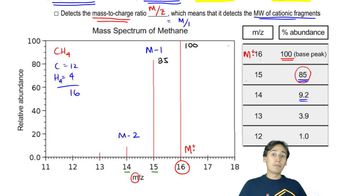
Mass spectrometry is an analytical technique used to measure the mass-to-charge ratio of ions. It involves ionizing chemical species and sorting the ions based on their mass. The resulting mass spectrum provides information about the molecular weight and structure of the compounds, allowing for the identification of fragments that are most abundant in a sample.
Recommended video:
Guided course
01:25
How to Read a Mass Spectrum

Fragmentation Patterns

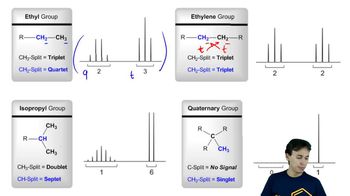
Fragmentation patterns refer to the specific ways in which a molecule breaks apart during mass spectrometry. These patterns are influenced by the molecular structure and stability of the resulting fragments. Understanding common fragmentation pathways helps predict which fragments will be most abundant in the mass spectrum, aiding in the identification of the original compound.
Recommended video:
Guided course
08:06
Common Splitting Patterns

Isomerism and Structural Representation

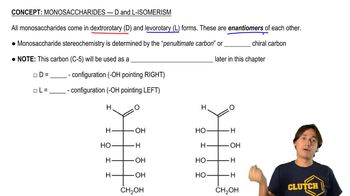
Isomerism is the phenomenon where compounds with the same molecular formula have different structures or arrangements of atoms. In the case of 2-methylpentane, recognizing its structural isomers is crucial for predicting the fragments observed in mass spectrometry. Accurate structural representation allows for better predictions of fragmentation and the resulting mass spectrum.
Recommended video:
Guided course
06:47
Monosaccharides - D and L Isomerism