Draw skeletal structures for the following: a. 5-ethyl-2-methyloctane
Verified step by step guidance
1
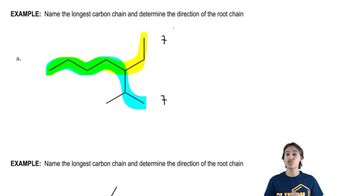
Step 1: Start by identifying the parent chain. The parent chain is 'octane,' which means it contains 8 carbon atoms in a straight chain. Draw a straight chain of 8 carbons.
Step 2: Number the carbon atoms in the parent chain from left to right (or right to left) to ensure the substituents are assigned the lowest possible numbers. This numbering will help place the substituents correctly.
Step 3: Identify the substituents. The name '5-ethyl' indicates an ethyl group (-CH₂CH₃) attached to the 5th carbon, and '2-methyl' indicates a methyl group (-CH₃) attached to the 2nd carbon.
Step 4: Add the substituents to the parent chain. Attach the ethyl group (-CH₂CH₃) to the 5th carbon and the methyl group (-CH₃) to the 2nd carbon of the parent chain.
Step 5: Verify the structure. Ensure that the skeletal structure correctly represents the parent chain and substituents, and confirm that the substituents are placed at the correct positions (2nd and 5th carbons).
Verified video answer for a similar problem:
This video solution was recommended by our tutors as helpful for the problem above
Video duration:
5m
Play a video:
0 Comments
Key Concepts
Here are the essential concepts you must grasp in order to answer the question correctly.
Skeletal Structures
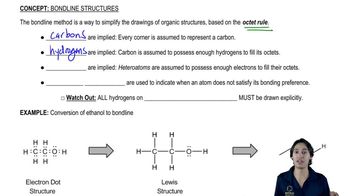
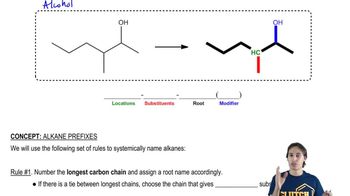
Skeletal structures, or line-angle formulas, are a simplified way of representing organic molecules. In these diagrams, carbon atoms are represented by vertices or ends of lines, while hydrogen atoms are typically omitted for clarity. This method allows chemists to visualize the connectivity and branching of carbon chains without cluttering the diagram with hydrogen atoms.
IUPAC nomenclature is a systematic method for naming organic chemical compounds. It provides rules for identifying the longest carbon chain, substituents, and their positions. In the case of '5-ethyl-2-methyloctane', the name indicates an eight-carbon chain (octane) with an ethyl group at the fifth carbon and a methyl group at the second carbon, which is essential for accurately drawing the skeletal structure.
Carbon chain branching refers to the presence of substituents attached to the main carbon chain in an organic molecule. In '5-ethyl-2-methyloctane', the main chain consists of eight carbon atoms, while the ethyl and methyl groups create branches. Understanding how to represent these branches in skeletal structures is crucial for accurately depicting the molecule's three-dimensional shape and connectivity.