Predict the product for the following substitution reactions. Indicate whether each reaction likely proceeds by an SN1 or SN2 mechanism. (c)
Verified step by step guidance
1
Step 1: Analyze the substrate structure. Determine whether the carbon attached to the leaving group is primary, secondary, or tertiary. This will help predict whether the reaction is likely to proceed via an S_N1 or S_N2 mechanism. Recall that tertiary carbons favor S_N1 due to carbocation stability, while primary carbons favor S_N2 due to steric hindrance considerations.
Step 2: Examine the nature of the leaving group. A good leaving group (e.g., halides like Cl⁻, Br⁻, or I⁻) facilitates both S_N1 and S_N2 mechanisms. Ensure the leaving group is capable of stabilizing the negative charge after departure.
Step 3: Consider the nucleophile. Strong nucleophiles (e.g., OH⁻, CN⁻, or alkoxides) favor S_N2 mechanisms, while weak nucleophiles (e.g., H₂O or alcohols) are more likely to proceed via S_N1 mechanisms.
Step 4: Evaluate the solvent. Polar protic solvents (e.g., water, alcohols) stabilize carbocations and favor S_N1 mechanisms, while polar aprotic solvents (e.g., acetone, DMSO) enhance nucleophilicity and favor S_N2 mechanisms.
Step 5: Combine all observations to predict the mechanism (S_N1 or S_N2) and the product. For S_N1, the product is formed after carbocation rearrangement (if applicable) and nucleophilic attack. For S_N2, the product is formed via a single-step backside attack, leading to inversion of configuration at the carbon center.
Verified video answer for a similar problem:
This video solution was recommended by our tutors as helpful for the problem above
Video duration:
3m
Play a video:
0 Comments
Key Concepts
Here are the essential concepts you must grasp in order to answer the question correctly.
S_N 1 Mechanism
The S_N 1 mechanism, or unimolecular nucleophilic substitution, involves a two-step process where the leaving group departs first, forming a carbocation intermediate. The nucleophile then attacks this positively charged intermediate. This mechanism is favored in tertiary substrates due to their ability to stabilize the carbocation, and it typically leads to racemization if the substrate is chiral.
The S_N 2 mechanism, or bimolecular nucleophilic substitution, occurs in a single concerted step where the nucleophile attacks the substrate at the same time as the leaving group departs. This mechanism is characterized by a backside attack, leading to inversion of configuration at the chiral center. S_N 2 reactions are favored in primary substrates due to less steric hindrance and require strong nucleophiles.
The choice between S_N 1 and S_N 2 mechanisms is influenced by several factors, including the structure of the substrate (primary, secondary, or tertiary), the strength and concentration of the nucleophile, the nature of the leaving group, and the solvent used. Polar protic solvents favor S_N 1 by stabilizing the carbocation, while polar aprotic solvents enhance S_N 2 reactions by better solvating the nucleophile.

 3:30 minutes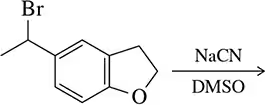
 Verified step by step guidance
 04:32
04:32