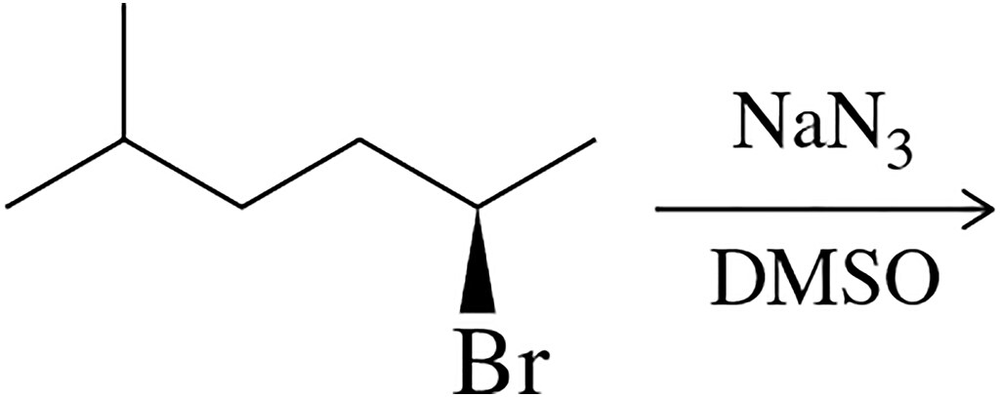
Would you expect the following substitution reaction to proceed with inversion or racemization? Why?
Verified step by step guidance
1
Identify the type of substitution reaction (SN1 or SN2) by analyzing the substrate, nucleophile, solvent, and leaving group. SN1 reactions typically occur with tertiary substrates and polar protic solvents, while SN2 reactions favor primary substrates and polar aprotic solvents.
Understand the stereochemical outcome of each mechanism: SN1 reactions proceed through a carbocation intermediate, which allows for planar geometry and can lead to racemization. SN2 reactions involve a backside attack by the nucleophile, leading to inversion of configuration.
Examine the substrate structure. If the carbon undergoing substitution is chiral, the stereochemical outcome will depend on the mechanism. For SN1, the planar carbocation intermediate allows the nucleophile to attack from either side, leading to a mixture of enantiomers (racemization). For SN2, the backside attack ensures inversion of configuration.
Consider the role of the nucleophile and solvent. A strong nucleophile and polar aprotic solvent favor SN2, while a weak nucleophile and polar protic solvent favor SN1. This will help determine the likely mechanism and stereochemical outcome.
Conclude whether the reaction proceeds with inversion or racemization based on the mechanism determined in the previous steps. If SN1 is favored, expect racemization. If SN2 is favored, expect inversion of configuration.
Verified video answer for a similar problem:
This video solution was recommended by our tutors as helpful for the problem above
Video duration:
2m
Play a video:
0 Comments
Key Concepts
Here are the essential concepts you must grasp in order to answer the question correctly.
Nucleophilic Substitution Mechanisms
Nucleophilic substitution reactions can occur via two primary mechanisms: SN1 and SN2. In SN2 reactions, the nucleophile attacks the electrophile in a single concerted step, leading to inversion of configuration at the chiral center. In contrast, SN1 reactions involve a two-step process where the leaving group departs first, forming a carbocation, which can then be attacked by the nucleophile from either side, potentially resulting in racemization.
Nucleophiles and Electrophiles can react in Substitution Reactions.
Stereochemistry
Stereochemistry is the study of the spatial arrangement of atoms in molecules and how this affects their chemical behavior. In substitution reactions, the stereochemical outcome is crucial; inversion occurs in SN2 reactions due to the backside attack of the nucleophile, while racemization can occur in SN1 reactions due to the planar nature of the carbocation intermediate, allowing for attack from either side.
Chirality refers to the property of a molecule that makes it non-superimposable on its mirror image, often due to the presence of a chiral center. Molecules that are chiral can exhibit optical activity, rotating plane-polarized light. In substitution reactions, the outcome—whether inversion or racemization—affects the optical activity of the product, which is essential for predicting the behavior of the resulting compounds.