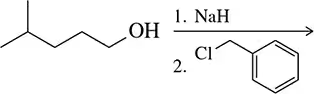
Predict the product for the following substitution reactions. Indicate whether each reaction likely proceeds by an SN1 or SN2 mechanism. (a)
Verified step by step guidance
1
Identify the substrate in the reaction. Determine whether it is primary, secondary, or tertiary, as this will influence the mechanism (S_N1 or S_N2).
Consider the nature of the nucleophile. Strong nucleophiles favor S_N2 reactions, while weak nucleophiles are more likely to participate in S_N1 reactions.
Evaluate the solvent used in the reaction. Polar protic solvents tend to stabilize carbocations and favor S_N1 mechanisms, whereas polar aprotic solvents favor S_N2 mechanisms by stabilizing the nucleophile.
Analyze the leaving group. A good leaving group is essential for both S_N1 and S_N2 reactions, but it is especially crucial for S_N1 reactions where the leaving group departs before the nucleophile attacks.
Based on the substrate, nucleophile, solvent, and leaving group, predict whether the reaction will proceed via an S_N1 or S_N2 mechanism and draw the expected product, considering stereochemistry if applicable.
Verified video answer for a similar problem:
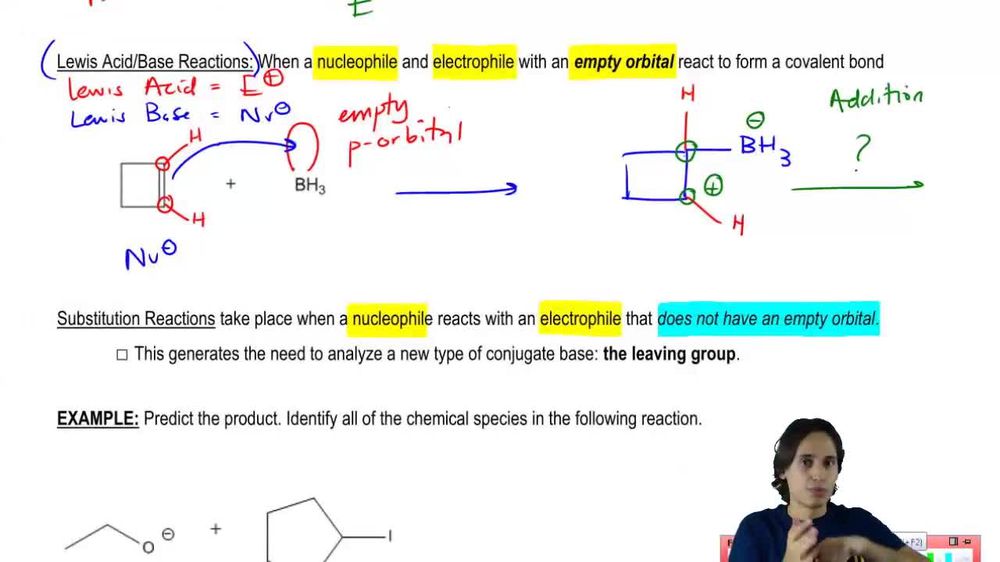
This video solution was recommended by our tutors as helpful for the problem above
Video duration:
3m
Play a video:
0 Comments
Key Concepts
Here are the essential concepts you must grasp in order to answer the question correctly.
Nucleophilic Substitution Reactions
Nucleophilic substitution reactions involve the replacement of a leaving group in a molecule by a nucleophile. These reactions are fundamental in organic chemistry and can proceed via two main mechanisms: S_N1 and S_N2. Understanding the nature of the nucleophile, the substrate, and the leaving group is crucial for predicting the reaction outcome.
Nucleophiles and Electrophiles can react in Substitution Reactions.
S_N1 Mechanism
The S_N1 mechanism is a two-step process where the leaving group departs first, forming a carbocation intermediate. This mechanism is favored in tertiary substrates due to carbocation stability and typically occurs in polar protic solvents. The reaction rate depends only on the concentration of the substrate, making it unimolecular.
The S_N2 mechanism is a one-step process where the nucleophile attacks the substrate simultaneously as the leaving group departs. This mechanism is favored in primary substrates and occurs in polar aprotic solvents. The reaction rate depends on both the substrate and nucleophile concentrations, making it bimolecular and leading to inversion of configuration at the reaction site.