When sodium generates electrons in the presence of ammonia, these electrons persist in solution, giving the blue color. However, electrons do not persist when sodium is added to water. Why?
Verified step by step guidance
1
Understand the behavior of sodium in both ammonia and water: Sodium (Na) is a highly reactive alkali metal. When it reacts with ammonia (NH₃), it generates solvated electrons, which are free electrons stabilized by the ammonia molecules. These solvated electrons are responsible for the blue color of the solution. In contrast, when sodium reacts with water (H₂O), the reaction is much more vigorous and does not produce solvated electrons.
Analyze the reaction of sodium with ammonia: Sodium reacts with liquid ammonia to form sodium amide (NaNH₂) and solvated electrons. The reaction can be represented as: . The solvated electrons are stabilized by the ammonia molecules, allowing them to persist in solution.
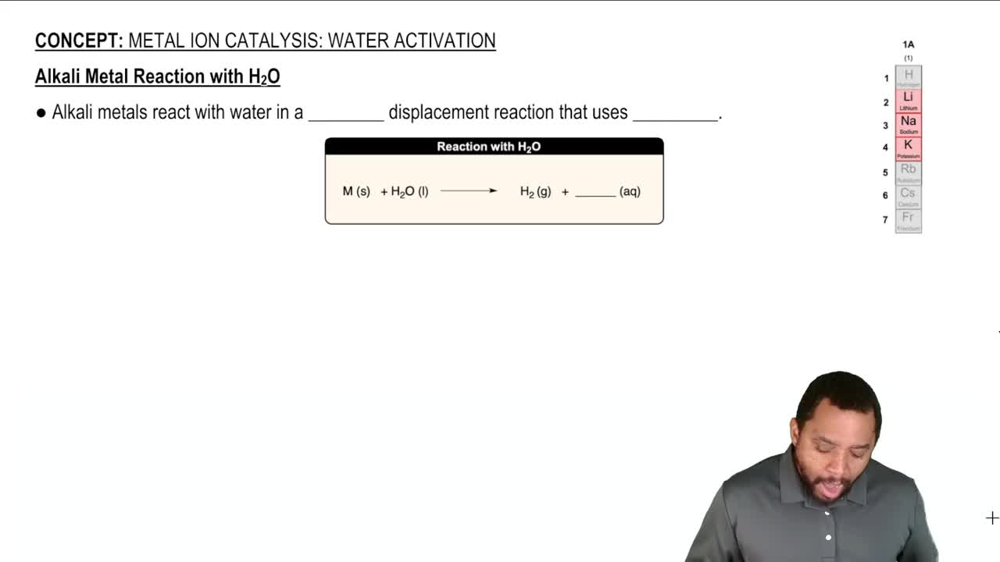
Examine the reaction of sodium with water: Sodium reacts with water to form sodium hydroxide (NaOH) and hydrogen gas (H₂). The reaction is highly exothermic and can be represented as: . In this reaction, the electrons from sodium are immediately consumed in the formation of hydroxide ions (OH⁻) and hydrogen gas, leaving no free electrons to persist in solution.
Compare the stabilization of electrons in ammonia versus water: In ammonia, the solvated electrons are stabilized by the polar nature of ammonia molecules, which form a solvation shell around the electrons. In water, however, the electrons are not stabilized because they are rapidly consumed in the chemical reaction to form hydroxide ions and hydrogen gas. This difference in stabilization explains why electrons persist in ammonia but not in water.
Conclude the reasoning: The key difference lies in the nature of the reactions and the stabilization of electrons. In ammonia, the reaction produces solvated electrons that are stabilized by the solvent, resulting in the blue color. In water, the reaction is too vigorous, and the electrons are immediately consumed, preventing their persistence in solution.
Verified video answer for a similar problem:
This video solution was recommended by our tutors as helpful for the problem above
Video duration:
3m
Play a video:
0 Comments
Key Concepts
Here are the essential concepts you must grasp in order to answer the question correctly.
Electron Generation and Persistence
In the context of sodium and ammonia, sodium donates electrons, which can remain in solution due to the solvent's properties. Ammonia, being a polar solvent, stabilizes the generated electrons, allowing them to persist and contribute to the blue color observed. This contrasts with water, where the high dielectric constant and reactivity lead to rapid electron consumption.
The choice of solvent significantly influences the behavior of solutes. In ammonia, the solvent's ability to stabilize charged species allows for the retention of free electrons. In contrast, water's strong hydrogen bonding and high polarity facilitate the rapid reaction of sodium with water, leading to the formation of sodium hydroxide and hydrogen gas, which consumes the electrons.
Chemical Reactions of Phosphate Anhydrides Concept 1
Sodium's Reactivity with Water vs. Ammonia
Sodium is highly reactive with water, resulting in an exothermic reaction that produces sodium hydroxide and hydrogen gas. This reaction is vigorous and leads to the immediate consumption of electrons. In ammonia, however, the reaction is less vigorous, allowing for the stabilization of electrons in solution, which is why the blue color persists in ammonia but not in water.

 3:52 minutes
 Verified step by step guidance
 03:54
03:54