Predict the product of the following hydrogenation reactions run with a poisoned catalyst. (b)
Verified step by step guidance
1
Identify the type of reaction: Hydrogenation with a poisoned catalyst typically refers to a partial hydrogenation reaction. A common example is the use of Lindlar's catalyst, which selectively hydrogenates alkynes to cis-alkenes without further reducing the alkene to an alkane.
Examine the starting material: Determine if the compound is an alkyne, as this is the typical substrate for partial hydrogenation with a poisoned catalyst. If it is an alkyne, note whether it is terminal or internal.
Understand the stereochemistry: Hydrogenation with a poisoned catalyst like Lindlar's catalyst adds hydrogen atoms to the alkyne in a syn-addition manner, resulting in a cis-alkene as the product.
Write the reaction mechanism: Show the addition of hydrogen atoms to the triple bond of the alkyne, breaking one π-bond to form a double bond. Ensure that the hydrogens are added to the same side of the molecule to produce the cis-alkene.
Predict the product: Based on the mechanism and stereochemistry, draw the structure of the resulting cis-alkene. Ensure that the product reflects the selective partial hydrogenation and does not proceed to a fully saturated alkane.
Verified video answer for a similar problem:
This video solution was recommended by our tutors as helpful for the problem above
Video duration:
2m
Play a video:
0 Comments
Key Concepts
Here are the essential concepts you must grasp in order to answer the question correctly.
Hydrogenation
Hydrogenation is a chemical reaction that involves the addition of hydrogen (H2) to unsaturated organic compounds, typically alkenes or alkynes, converting them into saturated hydrocarbons. This process is commonly facilitated by catalysts, which increase the reaction rate without being consumed. The reaction can lead to the formation of alkanes, and the conditions under which it occurs can significantly influence the product distribution.
A poisoned catalyst is a catalyst that has been intentionally modified or contaminated to reduce its activity. In hydrogenation reactions, a poisoned catalyst can selectively inhibit certain pathways, leading to specific products rather than a complete saturation of all double or triple bonds. This is particularly useful in organic synthesis, where controlling the degree of hydrogenation is crucial for obtaining desired compounds.
Regioselectivity refers to the preference of a chemical reaction to occur at one location over another in a molecule, resulting in the formation of a specific isomer. In the context of hydrogenation reactions, the regioselectivity can be influenced by the type of catalyst used, including poisoned catalysts, which can favor the addition of hydrogen to certain positions on a double bond. Understanding regioselectivity is essential for predicting the outcome of reactions and designing synthetic pathways.

 2:18 minutes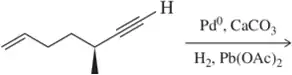
 Verified step by step guidance
 00:48
00:48