Predict the product of the following hydrogenation reactions run with a poisoned catalyst. (c)
Verified step by step guidance
1
Step 1: Understand the concept of hydrogenation with a poisoned catalyst. A poisoned catalyst, such as Lindlar's catalyst, is used to selectively hydrogenate alkynes to alkenes without further reducing the alkene to an alkane.
Step 2: Identify the starting material in the reaction. Determine whether the compound is an alkyne, alkene, or another functional group that can undergo hydrogenation.
Step 3: Recognize the stereochemistry of the reaction. Hydrogenation with a poisoned catalyst typically results in a cis-alkene (Z-configuration) due to the syn addition of hydrogen atoms.
Step 4: Write the reaction mechanism. Show how the alkyne interacts with the poisoned catalyst and hydrogen gas to form the cis-alkene. Use MathML to represent the chemical structures and reaction arrows.
Step 5: Predict the product based on the mechanism and stereochemistry. Ensure the product is a cis-alkene and verify that no further reduction occurs due to the poisoned catalyst.
Verified video answer for a similar problem:
This video solution was recommended by our tutors as helpful for the problem above
Video duration:
2m
Play a video:
0 Comments
Key Concepts
Here are the essential concepts you must grasp in order to answer the question correctly.
Hydrogenation
Hydrogenation is a chemical reaction that involves the addition of hydrogen (H2) to unsaturated organic compounds, typically alkenes or alkynes, converting them into saturated hydrocarbons. This process is commonly facilitated by catalysts, which speed up the reaction without being consumed. The reaction can lead to the formation of alkanes, and the conditions under which it occurs can significantly influence the product distribution.
A poisoned catalyst is a catalyst that has been intentionally modified or contaminated to reduce its activity. In hydrogenation reactions, a poisoned catalyst can selectively inhibit the reaction of certain double bonds while allowing others to react. This selectivity is crucial in synthetic organic chemistry, as it can lead to the formation of specific products rather than a mixture, thus allowing for more controlled reactions.
Selectivity refers to the preference of a chemical reaction to produce one product over others when multiple potential products are possible. In the context of hydrogenation with a poisoned catalyst, selectivity is influenced by the nature of the catalyst and the substrate. Understanding selectivity is essential for predicting the outcome of reactions, especially in complex organic synthesis where multiple functional groups may be present.

 2:10 minutes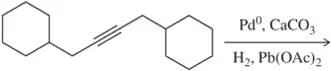
 Verified step by step guidance
 00:48
00:48