Describe the orbitals used in bonding and the bond angles in the following compounds: c. H2CO
Verified step by step guidance
1
Identify the central atom in the molecule H₂CO. In this case, the central atom is carbon (C).
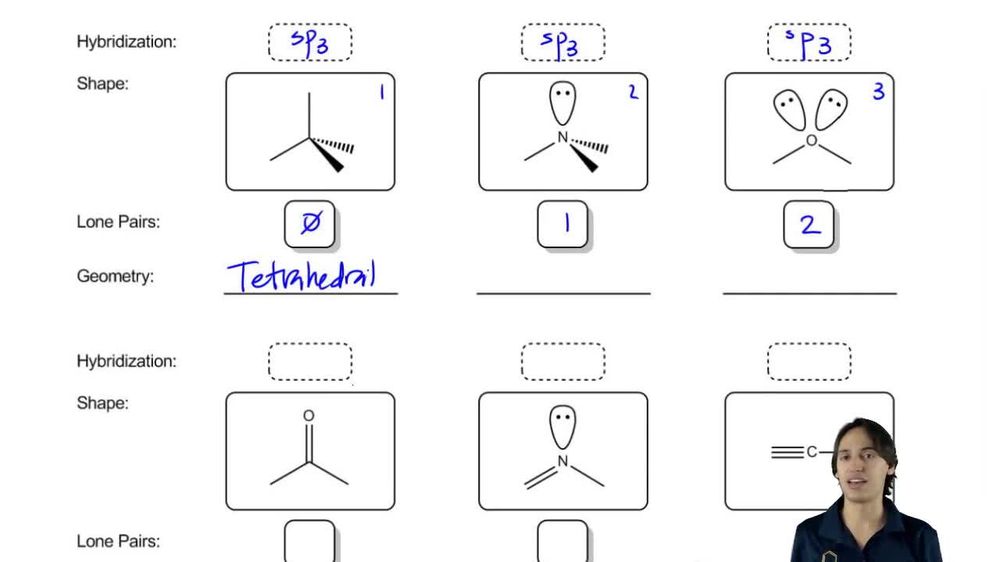
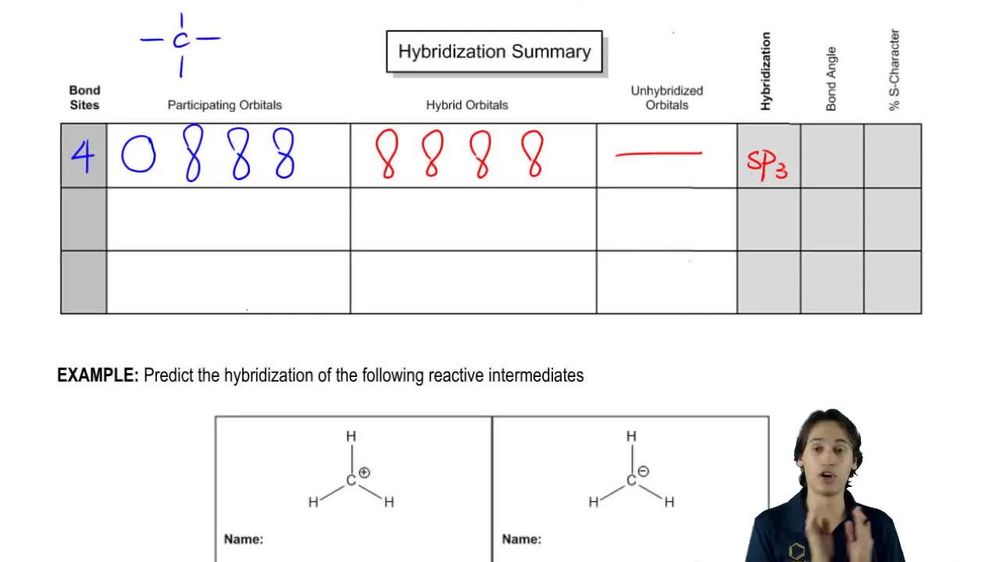
Determine the hybridization of the central atom. Carbon in H₂CO forms a double bond with oxygen and two single bonds with hydrogen atoms. This indicates sp² hybridization, as one s orbital and two p orbitals mix to form three sp² hybrid orbitals.
Describe the orbitals involved in bonding. The carbon atom uses its sp² hybrid orbitals to form sigma (σ) bonds with the two hydrogen atoms and one sigma bond with the oxygen atom. The remaining unhybridized p orbital on carbon overlaps with a p orbital on oxygen to form a pi (π) bond, completing the double bond.
Explain the bond angles. In sp² hybridization, the three sp² orbitals are arranged in a trigonal planar geometry around the central atom, resulting in bond angles of approximately 120°.
Summarize the bonding and geometry. The molecule H₂CO has a trigonal planar geometry around the carbon atom, with sp² hybrid orbitals forming sigma bonds and a p orbital forming a pi bond in the double bond with oxygen.
Verified video answer for a similar problem:
This video solution was recommended by our tutors as helpful for the problem above
Video duration:
5m
Play a video:
0 Comments
Key Concepts
Here are the essential concepts you must grasp in order to answer the question correctly.
Hybridization
Hybridization is the process by which atomic orbitals mix to form new hybrid orbitals that are suitable for the pairing of electrons to form chemical bonds. In H2CO (formaldehyde), the central carbon atom undergoes sp2 hybridization, resulting in three equivalent sp2 hybrid orbitals that are arranged in a trigonal planar geometry.
Bond angles are the angles formed between adjacent bonds in a molecule, which are influenced by the arrangement of hybrid orbitals. In H2CO, the bond angles around the carbon atom are approximately 120 degrees due to its sp2 hybridization, reflecting the trigonal planar structure of the molecule.
Molecular geometry refers to the three-dimensional arrangement of atoms in a molecule. For H2CO, the molecular geometry is trigonal planar, which is characterized by the carbon atom at the center with two hydrogen atoms and one oxygen atom bonded to it, leading to a flat structure that affects the molecule's reactivity and properties.