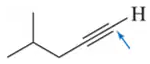
Determine the oxidation number of each carbon indicated by an arrow. (f)
Verified step by step guidance
1
Identify the carbon atom indicated by the arrow in the structure. This is the carbon atom that is part of the alkyne group, specifically the terminal carbon bonded to a hydrogen atom.
Recall the general rule for determining oxidation numbers: assign electrons in a bond to the more electronegative atom. For C-H bonds, carbon is more electronegative than hydrogen, so carbon gets both electrons.
For the carbon-carbon triple bond, each carbon atom shares electrons equally, so each carbon gets one electron from each of the three bonds.
Calculate the oxidation number for the indicated carbon: start with the valence electron count for carbon (4 electrons), then add or subtract electrons based on the bonds. Gain of electrons is negative, loss is positive.
Sum the electrons assigned to the carbon: 4 (valence) - 1 (from C-H bond) - 3 (from C≡C bond) = oxidation number. The result will give you the oxidation state of the indicated carbon atom.
Verified video answer for a similar problem:
This video solution was recommended by our tutors as helpful for the problem above
Play a video:
0 Comments
Key Concepts
Here are the essential concepts you must grasp in order to answer the question correctly.
Oxidation Number
The oxidation number, or oxidation state, is a theoretical charge assigned to an atom in a molecule, reflecting its degree of oxidation. It helps in understanding electron transfer in redox reactions. For carbon, common oxidation states range from -4 in methane (CH4) to +4 in carbon dioxide (CO2), depending on the number of bonds to more electronegative atoms.
Electronegativity is the tendency of an atom to attract electrons in a chemical bond. In determining oxidation numbers, the relative electronegativities of atoms are crucial; more electronegative atoms (like oxygen) will pull electron density away from less electronegative ones (like carbon), affecting the oxidation state assigned to carbon.
Lewis structures are diagrams that represent the bonding between atoms in a molecule and the lone pairs of electrons that may exist. They are essential for visualizing how atoms are connected and for determining the oxidation states of individual atoms, including carbon, by showing the distribution of electrons and the types of bonds formed.

 Verified step by step guidance
 03:40
03:40