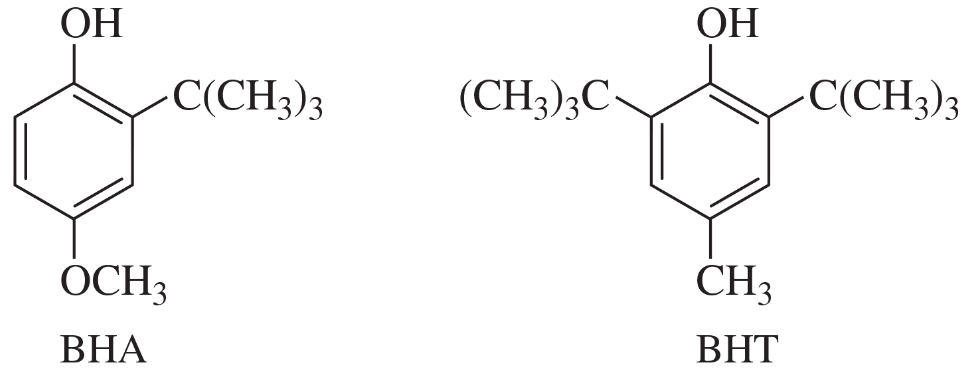
The antioxidants BHA and BHT are commonly used as food preservatives. Show how BHA and BHT can be made from phenol and hydroquinone
Verified step by step guidance
1
Step 1: Begin with phenol (C₆H₅OH) and hydroquinone (C₆H₄(OH)₂) as the starting materials. Phenol has one hydroxyl group attached to a benzene ring, while hydroquinone has two hydroxyl groups attached to a benzene ring in a para configuration.
Step 2: To synthesize BHA (butylated hydroxyanisole), perform an alkylation reaction on phenol. Use tert-butyl chloride (C(CH₃)₃Cl) as the alkylating agent and a Lewis acid catalyst such as AlCl₃ to introduce the tert-butyl group at the para position relative to the hydroxyl group. Then, methylate the hydroxyl group using dimethyl sulfate or methyl iodide to form the methoxy group (-OCH₃).
Step 3: To synthesize BHT (butylated hydroxytoluene), start with hydroquinone. Perform an alkylation reaction using tert-butyl chloride (C(CH₃)₃Cl) and a Lewis acid catalyst (e.g., AlCl₃) to introduce tert-butyl groups at the ortho and para positions relative to one of the hydroxyl groups. Then, methylate one hydroxyl group using dimethyl sulfate or methyl iodide to form the methyl group (-CH₃).
Step 4: Ensure regioselectivity during the alkylation reactions by controlling the reaction conditions and using appropriate catalysts. The tert-butyl groups are introduced at specific positions due to the electronic and steric effects of the hydroxyl groups.
Step 5: Purify the products (BHA and BHT) using techniques such as recrystallization or chromatography to remove any unreacted starting materials or side products. Confirm the structures using spectroscopic methods like NMR or IR.
Verified video answer for a similar problem:
This video solution was recommended by our tutors as helpful for the problem above
Video duration:
2m
Play a video:
0 Comments
Key Concepts
Here are the essential concepts you must grasp in order to answer the question correctly.
Phenol and Hydroquinone
Phenol is a simple aromatic compound with a hydroxyl group (-OH) attached to a benzene ring, while hydroquinone has two hydroxyl groups on the benzene ring. Both compounds serve as precursors in organic synthesis, particularly in the formation of antioxidants like BHA and BHT. Understanding their structures and reactivity is crucial for manipulating them in chemical reactions.
Antioxidants are substances that inhibit oxidation, a chemical reaction that can produce free radicals leading to chain reactions that may damage cells. BHA (Butylated Hydroxyanisole) and BHT (Butylated Hydroxytoluene) are synthetic antioxidants derived from phenolic compounds, widely used in food preservation to prevent rancidity and extend shelf life. Their mechanism involves donating electrons to free radicals, stabilizing them.
Synthetic Pathways
Synthetic pathways refer to the series of chemical reactions that transform starting materials into desired products. In the case of BHA and BHT, these pathways involve alkylation and methylation reactions of phenol and hydroquinone. Understanding these synthetic routes is essential for predicting the formation of these antioxidants and optimizing their production in a laboratory or industrial setting.