Chlorocyclohexane reacts with sodium cyanide (NaCN) in ethanol to give cyanocyclohexane. The rate of formation of cyanocyclohexane increases when a small amount of sodium iodide is added to the solution. Explain this acceleration in the rate.
Verified step by step guidance
1
Step 1: Recognize the type of reaction taking place. The reaction between chlorocyclohexane and sodium cyanide (NaCN) in ethanol is an example of an SN2 (bimolecular nucleophilic substitution) reaction. In this mechanism, the nucleophile (CN⁻) attacks the carbon bonded to the leaving group (Cl) in a single concerted step.
Step 2: Understand the role of the leaving group. The leaving group in this reaction is chloride (Cl⁻). The efficiency of an SN2 reaction depends significantly on the ability of the leaving group to depart. A better leaving group facilitates the reaction by stabilizing the negative charge after departure.
Step 3: Analyze the effect of sodium iodide (NaI). Sodium iodide dissociates in ethanol to produce iodide ions (I⁻). Iodide is a much better nucleophile and leaving group compared to chloride due to its larger size and ability to stabilize the negative charge. When iodide ions are present, they can replace the chloride ion on chlorocyclohexane via an SN2 reaction, forming iodo-cyclohexane as an intermediate.
Step 4: Explain the acceleration in the rate. The intermediate iodo-cyclohexane reacts with cyanide ions (CN⁻) much faster than chlorocyclohexane because iodide is a superior leaving group compared to chloride. This substitution process increases the overall rate of formation of cyanocyclohexane.
Step 5: Summarize the catalytic role of sodium iodide. Sodium iodide acts as a catalyst by facilitating the formation of iodo-cyclohexane, which accelerates the subsequent reaction with cyanide ions to produce cyanocyclohexane. This demonstrates how the presence of a better leaving group can enhance the rate of an SN2 reaction.
Verified video answer for a similar problem:
This video solution was recommended by our tutors as helpful for the problem above
Video duration:
6m
Play a video:
0 Comments
Key Concepts
Here are the essential concepts you must grasp in order to answer the question correctly.
Nucleophilic Substitution Reactions
Nucleophilic substitution reactions involve the replacement of a leaving group in a molecule by a nucleophile. In this case, sodium cyanide acts as a nucleophile that attacks the carbon atom bonded to the chlorine in chlorocyclohexane, leading to the formation of cyanocyclohexane. Understanding the mechanism of these reactions, particularly whether they proceed via an SN1 or SN2 pathway, is crucial for analyzing reaction rates.
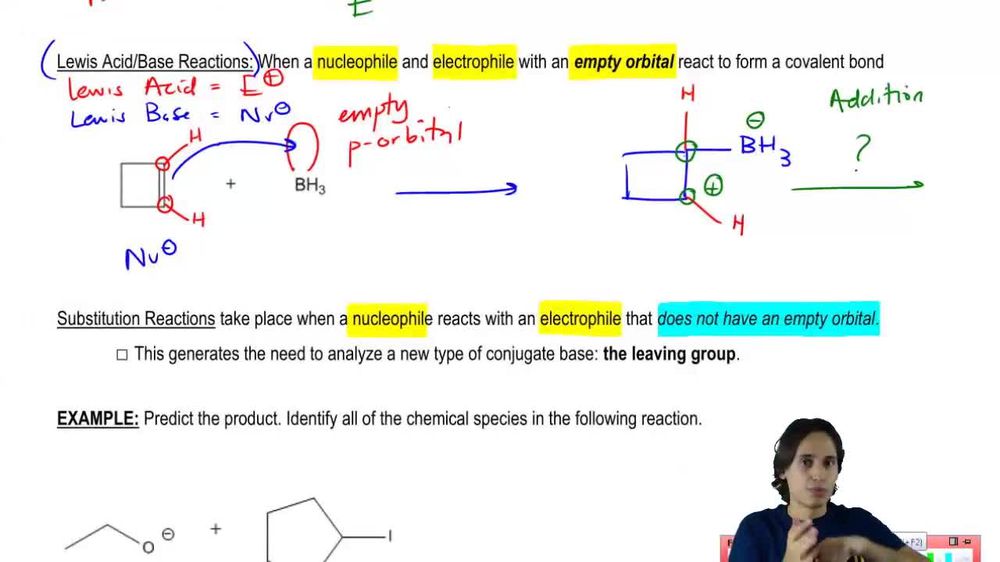
Nucleophiles and Electrophiles can react in Substitution Reactions.
Role of Sodium Iodide
Sodium iodide can enhance the reaction rate by providing a better leaving group compared to chloride. The presence of iodide ions can facilitate the formation of a more reactive intermediate or transition state, thereby increasing the overall rate of the nucleophilic substitution. This phenomenon is often referred to as the 'iodide effect' in organic chemistry.
The choice of solvent can significantly influence the rate of chemical reactions. In this scenario, ethanol serves as a polar protic solvent, which can stabilize charged intermediates and transition states. The solvent's ability to solvate ions and facilitate nucleophilic attack is essential for understanding how the addition of sodium iodide accelerates the formation of cyanocyclohexane.

 6:43 minutes
 Verified step by step guidance
 01:47
01:47