a. Optically active 2-bromobutane undergoes racemization on treatment with a solution of KBr. Give a mechanism for this racemization. b. In contrast, optically active butan-2-ol does not racemize on treatment with a solution of KOH. Explain why a reaction like that in part (a) does not occur.
Verified step by step guidance
1
Step 1: Understand the concept of racemization. Racemization occurs when an optically active compound (one that rotates plane-polarized light) is converted into a racemic mixture (equal amounts of enantiomers, which cancel out optical activity). This typically happens through a mechanism that allows for the formation of a planar intermediate or transition state, enabling attack from either side.
Step 2: Analyze the mechanism for the racemization of 2-bromobutane. When optically active 2-bromobutane is treated with KBr, the bromide ion (Br⁻) acts as a nucleophile. The reaction proceeds via an SN1 mechanism. In the first step, the C-Br bond breaks heterolytically, forming a planar carbocation intermediate. This planar intermediate can be attacked by the bromide ion from either side, leading to the formation of both enantiomers in equal amounts, resulting in racemization.
Step 3: Write the mechanism for the racemization of 2-bromobutane. The steps are as follows: (a) The C-Br bond breaks, forming a carbocation intermediate. (b) The bromide ion (Br⁻) attacks the planar carbocation from either side, leading to the formation of both R- and S-enantiomers. Use MathML to represent the chemical structures and reaction arrows if needed.
Step 4: Explain why butan-2-ol does not racemize under similar conditions. In the case of butan-2-ol, the hydroxyl group (-OH) is a poor leaving group compared to bromide (-Br). For racemization to occur, the leaving group must depart to form a carbocation intermediate. However, the -OH group does not leave easily under these conditions, and no carbocation intermediate is formed. Therefore, racemization does not occur.
Step 5: Summarize the key difference between the two cases. The racemization of 2-bromobutane occurs because bromide is a good leaving group, allowing the formation of a planar carbocation intermediate. In contrast, butan-2-ol does not racemize because the hydroxyl group is a poor leaving group, preventing the formation of a carbocation intermediate.
Verified video answer for a similar problem:
This video solution was recommended by our tutors as helpful for the problem above
Video duration:
8m
Play a video:
0 Comments
Key Concepts
Here are the essential concepts you must grasp in order to answer the question correctly.
Racemization
Racemization is the process by which an optically active compound converts into a racemic mixture, containing equal amounts of both enantiomers. This typically occurs through a reversible reaction that allows the chiral center to interconvert between its two configurations. In the case of 2-bromobutane, racemization can occur via an S_N1 mechanism, where the leaving group departs, forming a planar carbocation that can be attacked by nucleophiles from either side.
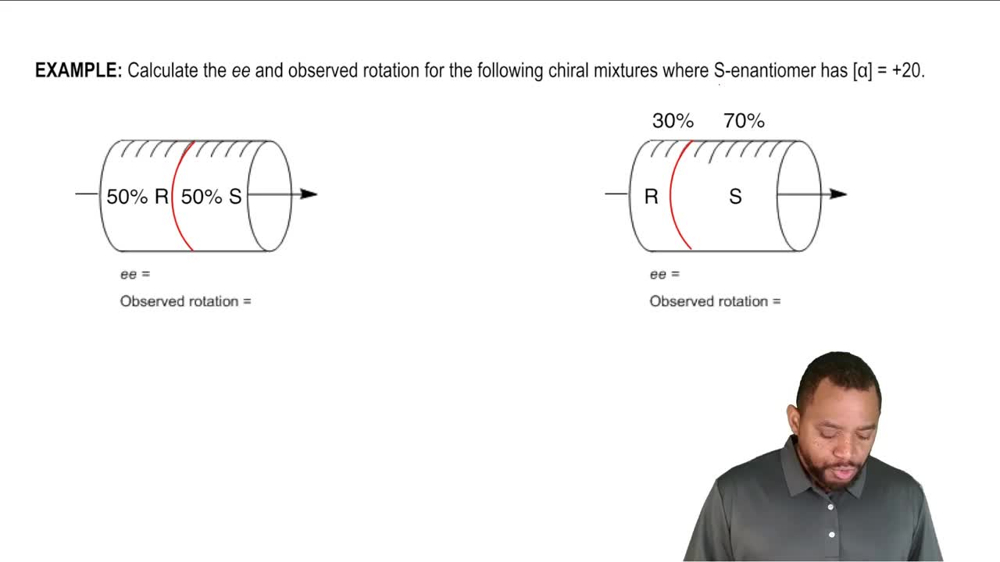
Calculating Enantiomeric Excess and Observed Rotation
S_N1 Mechanism
The S_N1 mechanism, or unimolecular nucleophilic substitution, involves two main steps: the formation of a carbocation intermediate and the subsequent nucleophilic attack. The rate-determining step is the formation of the carbocation, which is influenced by the stability of the carbocation and the solvent. In the case of 2-bromobutane, the presence of KBr facilitates the formation of a stable carbocation, allowing for racemization to occur.
The S_N2 mechanism, or bimolecular nucleophilic substitution, involves a single concerted step where the nucleophile attacks the substrate at the same time as the leaving group departs. This mechanism is characterized by a backside attack, leading to inversion of configuration at the chiral center. In the case of butan-2-ol with KOH, the reaction proceeds via S_N2, which does not allow for racemization because the nucleophile attacks the chiral center directly, preserving its stereochemistry.

 8:30 minutes
 Verified step by step guidance
 03:59
03:59