For each reaction, give the expected substitution product, and predict whether the mechanism will be predominantly first order (SN1) or second order (SN2). c. 1-iodo-1-methylcyclohexane + ethanol
Verified step by step guidance
1
Step 1: Analyze the substrate structure. The substrate is 1-iodo-1-methylcyclohexane, which is a tertiary (3°) halide because the carbon bonded to the iodine is also attached to three other carbons. This structural feature is important for determining the reaction mechanism.
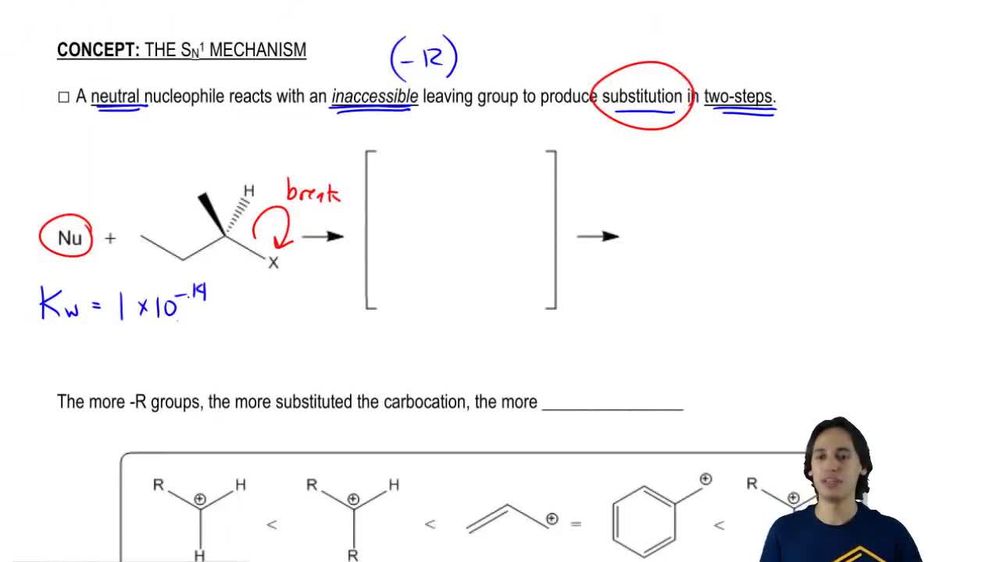
Step 2: Consider the nucleophile and solvent. Ethanol is a weak nucleophile and a polar protic solvent. Weak nucleophiles and polar protic solvents favor the SN1 mechanism because they stabilize the carbocation intermediate formed during the reaction.
Step 3: Evaluate the likelihood of SN2. SN2 reactions are unlikely with tertiary halides due to steric hindrance. The bulky groups around the carbon bonded to iodine prevent the nucleophile from attacking directly in a single step.
Step 4: Predict the mechanism. Based on the substrate (tertiary halide) and the weak nucleophile (ethanol), the reaction is expected to proceed via the SN1 mechanism. This involves a two-step process: (1) the leaving group (iodine) departs, forming a carbocation intermediate, and (2) the nucleophile (ethanol) attacks the carbocation.
Step 5: Determine the substitution product. In the SN1 mechanism, the nucleophile (ethanol) will attach to the carbocation intermediate, forming the substitution product. Since the carbocation is planar, the product may exhibit racemization if the carbon is chiral.
Verified video answer for a similar problem:
This video solution was recommended by our tutors as helpful for the problem above
Video duration:
7m
Play a video:
0 Comments
Key Concepts
Here are the essential concepts you must grasp in order to answer the question correctly.
Nucleophilicity
Nucleophilicity refers to the strength and reactivity of a nucleophile, which is a species that donates an electron pair to form a chemical bond. Strong nucleophiles, such as alkoxides or amines, are more likely to participate in bimolecular nucleophilic substitution (SN2) reactions, while weak nucleophiles, like water or alcohols, tend to favor unimolecular nucleophilic substitution (SN1) mechanisms.
SN1 and SN2 are two distinct mechanisms of nucleophilic substitution reactions. SN1 is a first-order reaction that involves the formation of a carbocation intermediate, typically favored by tertiary substrates and weak nucleophiles. In contrast, SN2 is a second-order reaction that occurs in a single concerted step, requiring strong nucleophiles and is generally favored by primary substrates due to steric accessibility.
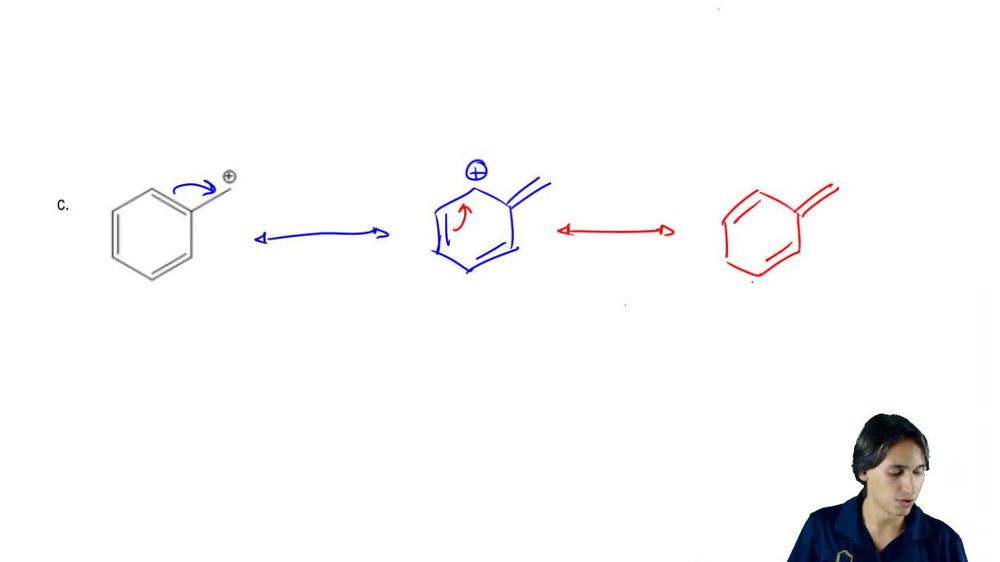
The structure of the substrate plays a crucial role in determining the mechanism of nucleophilic substitution. Tertiary (3°) substrates are more likely to undergo SN1 reactions due to the stability of the resulting carbocation, while primary (1°) substrates favor SN2 reactions. Additionally, resonance stabilization can influence the reactivity of certain substrates, making them more amenable to SN1 pathways even if they are primary.

 7:02 minutes
 Verified step by step guidance
 08:27
08:27