Give the expected products of the following reactions. Include a protonation step where necessary. (a) 2,2-dimethyloxirane + isopropylmagnesium bromide (b) propylene oxide + n-butyllithium (c) cyclopentyloxirane + ethyllithium
Verified step by step guidance
1
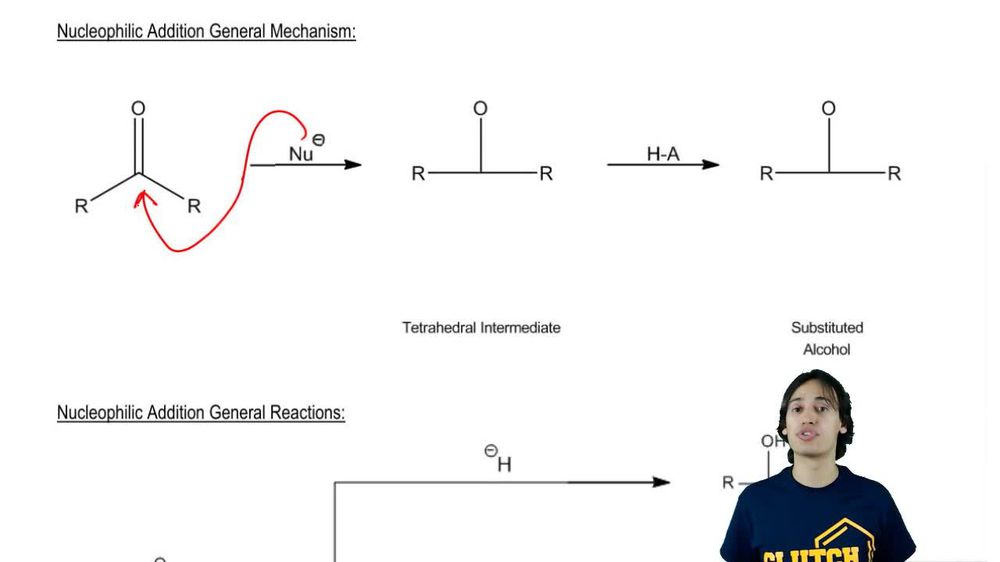
Step 1: Recognize that the reactions involve epoxides (oxiranes) and organometallic reagents (Grignard reagents or organolithium reagents). These reagents act as nucleophiles and open the epoxide ring via an SN2-like mechanism.
Step 2: Determine the site of nucleophilic attack. For unsymmetrical epoxides, the nucleophile attacks the less sterically hindered carbon of the epoxide ring. This is due to the SN2-like nature of the reaction.
Step 3: Write the mechanism for the nucleophilic attack. The nucleophile (e.g., isopropylmagnesium bromide, n-butyllithium, or ethyllithium) attacks the less hindered carbon of the epoxide, breaking the C-O bond and forming an alkoxide intermediate.
Step 4: Include the protonation step. The alkoxide intermediate is protonated by a proton source (e.g., water or an acid) to form the final alcohol product. Ensure the stereochemistry is considered if the epoxide is chiral.
Step 5: For each reaction, write the expected product. (a) 2,2-dimethyloxirane + isopropylmagnesium bromide yields a tertiary alcohol. (b) Propylene oxide + n-butyllithium yields a secondary alcohol. (c) Cyclopentyloxirane + ethyllithium yields a secondary alcohol. Ensure the regioselectivity and stereochemistry are consistent with the mechanism.
Verified video answer for a similar problem:
This video solution was recommended by our tutors as helpful for the problem above
Video duration:
9m
Play a video:
0 Comments
Key Concepts
Here are the essential concepts you must grasp in order to answer the question correctly.
Nucleophilic Addition to Epoxides
Epoxides are three-membered cyclic ethers that are highly reactive due to the strain in their ring structure. Nucleophiles can attack the less hindered carbon atom of the epoxide, leading to ring opening and the formation of an alcohol. Understanding the regioselectivity of this reaction is crucial for predicting the products when reacting epoxides with organometallic reagents.
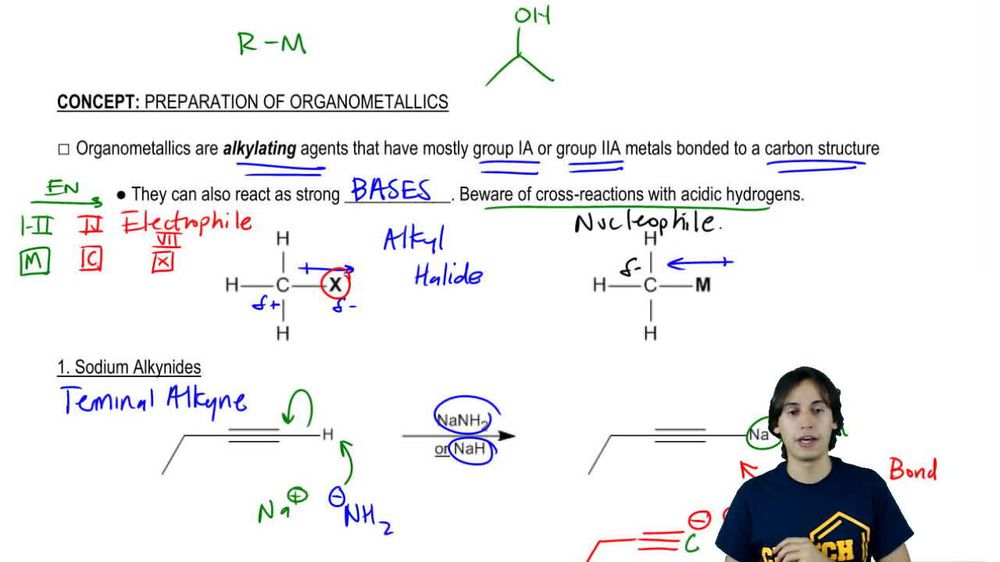
Organometallic reagents, such as Grignard reagents and organolithium compounds, are powerful nucleophiles that can react with electrophiles, including epoxides. They typically add to carbonyl groups or open epoxide rings, resulting in the formation of new carbon-carbon bonds. The reactivity and selectivity of these reagents depend on their structure and the nature of the electrophile.
In organic reactions, protonation steps are often necessary to convert negatively charged intermediates into neutral products. After nucleophilic attack and ring opening of an epoxide, the resulting alkoxide can be protonated by an acid, yielding an alcohol. Recognizing when and how to include protonation in reaction mechanisms is essential for accurately predicting final products.

 9:11 minutes
 Verified step by step guidance
 08:27
08:27