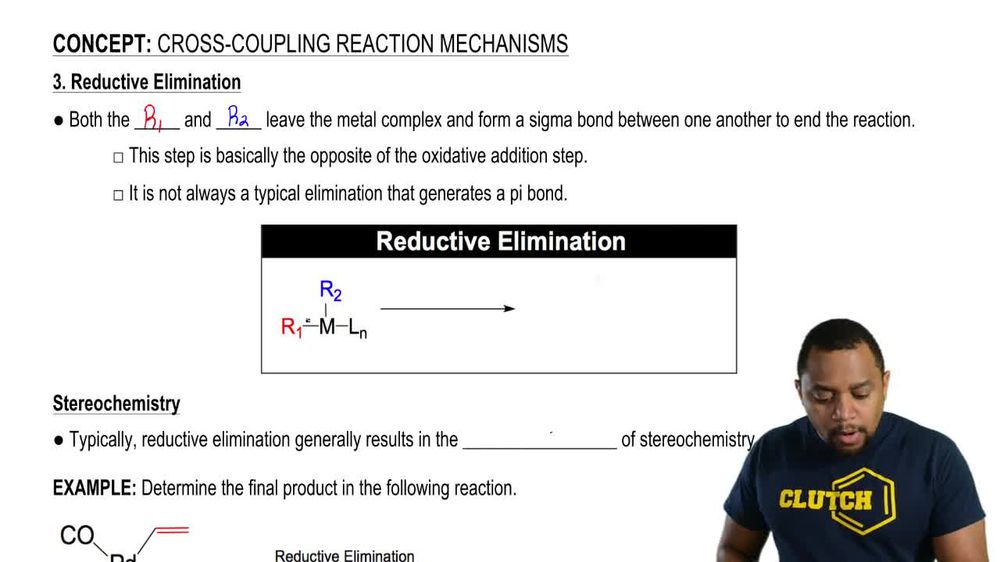
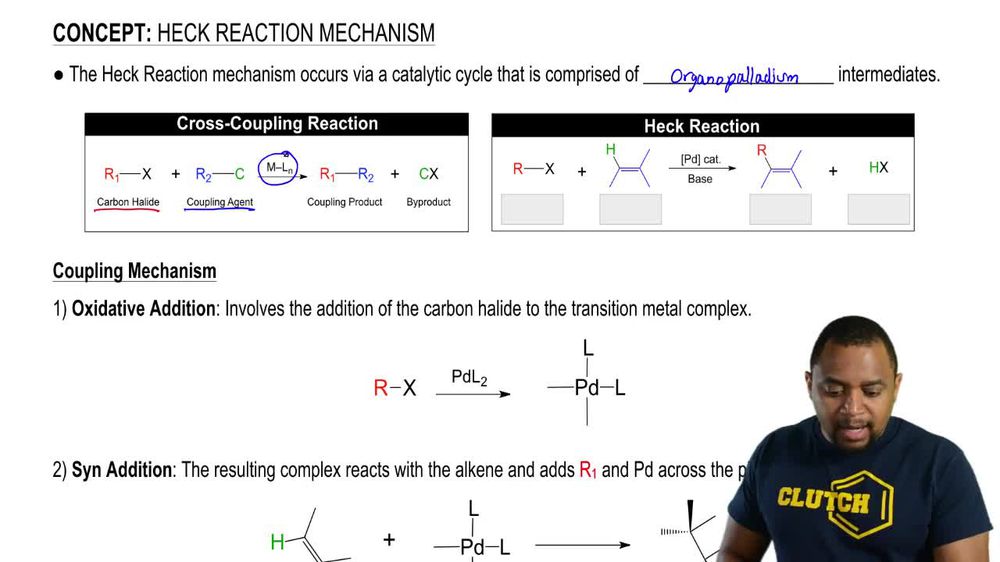
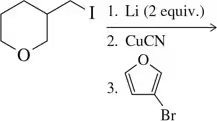
Predict the product of the diorganocuprate cross-coupling reactions shown. (a)
Verified step by step guidance
1
Identify the reactants involved in the diorganocuprate cross-coupling reaction. Typically, these reactions involve an organocuprate reagent (R2CuLi) and an organic halide (R'-X).
Understand the role of the organocuprate reagent. In this reaction, the organocuprate acts as a nucleophile, where one of the organic groups (R) will be transferred to the organic halide.
Determine the leaving group in the organic halide. The halide (X) is the leaving group, which will be replaced by the organic group from the organocuprate.
Predict the product by coupling the organic group from the organocuprate with the organic group from the halide. The new bond formed will be between the carbon of the organocuprate and the carbon of the organic halide.
Consider any stereochemical or regiochemical outcomes. If the organic halide is chiral or has multiple reactive sites, consider how the reaction conditions might affect the stereochemistry or regioselectivity of the product.
Verified video answer for a similar problem:
This video solution was recommended by our tutors as helpful for the problem above
Play a video:
0 Comments
Key Concepts
Here are the essential concepts you must grasp in order to answer the question correctly.
Diorganocuprate Reagents
Diorganocuprate reagents, also known as Gilman reagents, are organocopper compounds typically represented as R2CuLi. They are used in organic synthesis for forming carbon-carbon bonds through nucleophilic substitution reactions. These reagents are particularly useful for coupling with alkyl, aryl, or vinyl halides to form new carbon-carbon bonds, often with high selectivity and mild reaction conditions.
Cross-coupling reactions are a class of reactions where two different organic groups are joined together with the aid of a metal catalyst. In the context of diorganocuprate reagents, these reactions involve the coupling of an organocuprate with an organic halide to form a new carbon-carbon bond. The reaction typically proceeds through a mechanism involving oxidative addition, transmetalation, and reductive elimination, resulting in the formation of the desired coupled product.
Understanding the mechanism of diorganocuprate cross-coupling is crucial for predicting the reaction product. The mechanism generally involves the oxidative addition of the organic halide to the copper center, followed by transmetalation where the organic group from the cuprate is transferred to the metal center. Finally, reductive elimination occurs, forming the new carbon-carbon bond and regenerating the copper catalyst. This sequence ensures the selective formation of the desired product.

 Verified step by step guidance
 01:52
01:52